
How Modern Service Platforms Support Both Strategies
Machines and technical systems require regular maintenance to remain reliable. If you're managing equipment across multiple sites, you've probably asked yourself how and when maintenance interventions should occur. Over time, several maintenance strategies have been developed to help reduce equipment failures and ensure operational continuity.
Two of the most widely discussed strategies are preventive maintenance and predictive maintenance.
Both approaches aim to improve equipment reliability, but they operate according to different principles. Preventive maintenance focuses on scheduled interventions performed at regular intervals. Predictive maintenance relies on data analysis to identify when maintenance should occur based on equipment condition.
Understanding the relationship between these two strategies is important for organizations that manage large installation bases of machines. Modern service platforms support both approaches and allow organizations to combine them effectively.
What is predictive maintenance?
Preventive maintenance is based on the idea that machines should be inspected and maintained at regular intervals before failures occur.
Manufacturers often define maintenance schedules according to time intervals or operational usage. For example: Your conveyor system runs smoothly for months, then suddenly breaks down the week before your scheduled inspection.
These maintenance schedules are designed to reduce the likelihood of unexpected failures.
Technicians follow structured inspection procedures during preventive maintenance visits. Components are inspected, measurements are taken, and worn parts may be replaced even if they have not yet failed.
The objective is to maintain equipment reliability through routine service activities.
Preventive maintenance has been used successfully for decades in industries such as manufacturing, energy systems, building infrastructure, and industrial equipment.
Because maintenance schedules are predictable, organizations can plan technician activity and coordinate service visits efficiently.
How preventive maintenance programs operate
Preventive maintenance programs rely on structured planning and documentation.
Each machine in the installation base is associated with a maintenance schedule. These schedules may include different types of inspections and maintenance tasks.
For example, a machine may require basic inspections every three months, more detailed inspections annually, and component replacements every few years.
Service platforms allow organizations to configure these maintenance schedules within the system.
When a scheduled maintenance intervention becomes due, the system generates a work order for the service team.
Planning teams assign technicians to perform the intervention according to availability and location.
Technicians follow inspection procedures defined within the maintenance program.
Inspection results, measurements, and service observations are recorded within the service platform.
This documentation becomes part of the equipment history and allows organizations to track maintenance activity over time.
Advantages of preventive maintenance
Preventive maintenance provides several operational advantages.
Because interventions are scheduled in advance, service teams can plan technician activity efficiently. Maintenance visits can often be coordinated with other service tasks in the same region.
Routine inspections also help technicians detect potential issues before they develop into serious failures.
By replacing worn components early, organizations reduce the risk of unexpected breakdowns.
Preventive maintenance programs also support compliance in regulated environments.
Many industries require documented inspections and maintenance procedures to ensure equipment safety and reliability.
Structured maintenance schedules help organizations demonstrate that these requirements are fulfilled.
Limitations of preventive maintenance
Despite its benefits, preventive maintenance has certain limitations.
Because maintenance interventions occur at fixed intervals, some components may be replaced earlier than necessary. Parts may still be functioning properly but are replaced as part of the scheduled maintenance program.
In other situations, failures may occur between scheduled inspections.
A machine component may deteriorate unexpectedly before the next preventive maintenance visit.
Preventive maintenance therefore reduces risk but does not eliminate the possibility of unexpected failures.
As equipment becomes more complex and data collection improves, organizations increasingly explore predictive maintenance strategies to complement preventive programs.
Understanding predictive maintenance
Imagine a wind farm operator who receives an alert that turbine vibrations are 15% above normal. They schedule repairs during low-wind periods, avoiding a $50,000 emergency shutdown. That's predictive maintenance saving real money.
Predictive maintenance focuses on identifying when maintenance should occur based on equipment condition rather than fixed schedules.
Instead of relying solely on calendar intervals or operating hours, predictive strategies analyze operational data to determine when components are likely to fail.
This approach requires access to equipment performance data and historical service records.
Measurements collected during inspections, sensor data generated by machines, and maintenance history can all contribute to predictive analysis.
By examining patterns in this data, organizations can estimate the probability of component failure.
Maintenance interventions can then be scheduled when the data indicates that equipment condition is deteriorating.
This allows service teams to intervene before failures occur while avoiding unnecessary maintenance tasks.
The role of service data in predictive maintenance
Predictive maintenance relies heavily on structured service data.
Service platforms collect large volumes of operational information during maintenance and repair activities.
Technicians record inspection measurements, service observations, and parts replacements during each intervention.
Over time this information forms a detailed dataset describing how machines behave and how components wear under operational conditions.
Data analysis tools can examine this dataset to identify patterns.
For example, if a particular component consistently fails after a certain number of operating hours, predictive models can identify machines approaching that threshold.
Maintenance interventions can then be scheduled before failure occurs.
This approach improves reliability while optimizing maintenance resources.
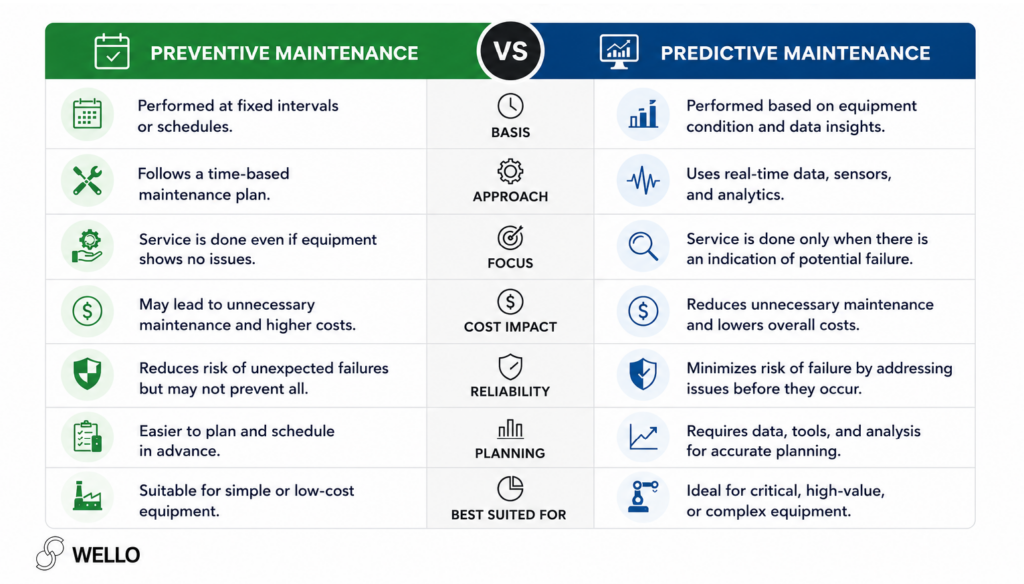
So which one should you choose? Let's break down the key differences:
The contribution of artificial intelligence
Artificial intelligence technologies have significantly expanded the capabilities of predictive maintenance.
AI systems can analyze large datasets generated by service platforms and identify patterns that may not be immediately visible through manual analysis.
Service reports, inspection measurements, parts usage, and technician observations can all contribute to predictive models.
AI analysis can highlight recurring issues associated with specific equipment types or operating conditions.
The system may detect that certain machines exhibit similar patterns before failures occur.
By identifying these patterns, AI systems can provide recommendations for maintenance interventions.
Service managers and technicians can then evaluate these recommendations and determine the appropriate actions.
AI therefore functions as a decision support tool that enhances maintenance planning.
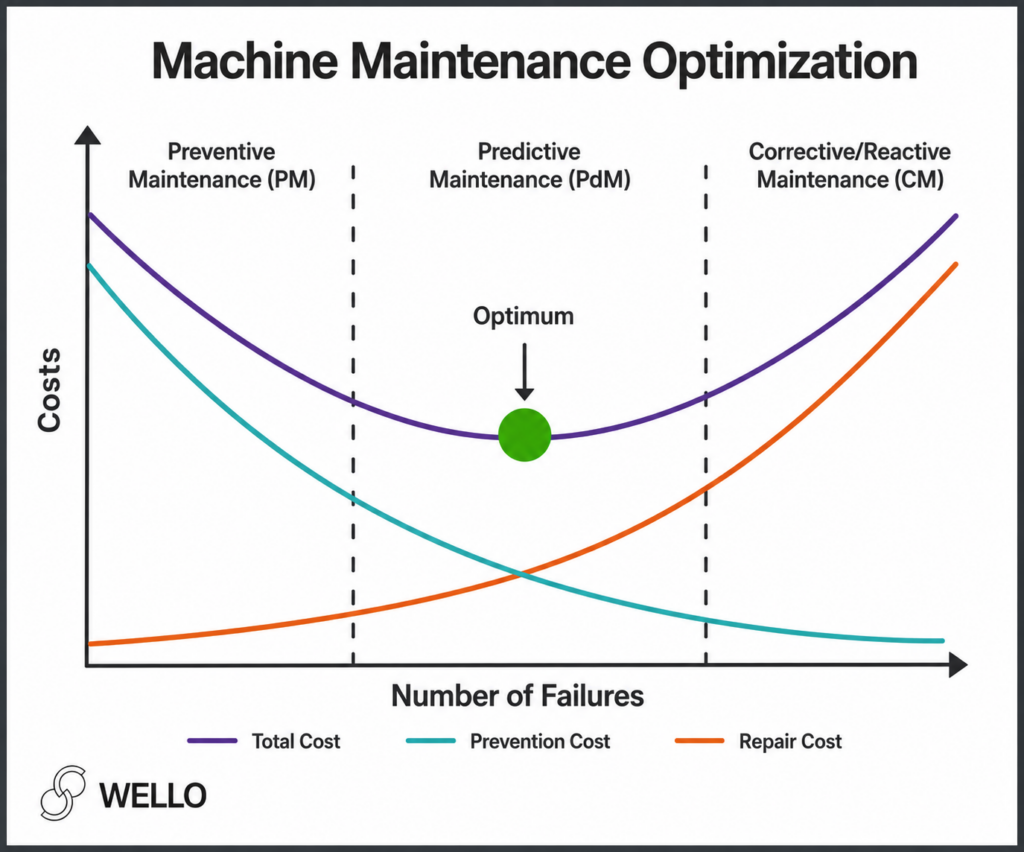
Machine maintenance optimization chart
Combining preventive and predictive maintenance
Preventive and predictive maintenance are often presented as competing strategies.
In practice, most service organizations benefit from combining both approaches.
Preventive maintenance provides a structured foundation for maintenance programs.
Scheduled inspections ensure that equipment is regularly examined and documented.
Predictive maintenance adds an additional layer of intelligence by analyzing operational data.
When predictive analysis identifies potential risks, maintenance interventions can be scheduled outside of the regular preventive schedule.
This combination allows organizations to maintain reliable service operations while improving efficiency.
Preventive maintenance ensures consistency. Predictive maintenance adds flexibility and responsiveness.
How service platforms support both strategies
Modern service platforms are designed to support both preventive and predictive maintenance approaches.
Preventive maintenance schedules can be configured within the platform.
The system automatically generates work orders when scheduled inspections become due.
Technicians follow structured procedures using forms and checklists during these interventions.
Inspection results and service documentation remain stored within equipment records.
At the same time, service platforms collect operational data that supports predictive analysis.
Service reports, inspection measurements, parts usage, and technician observations create datasets describing equipment performance.
Advanced analytics and AI tools can analyze this data to identify maintenance patterns.
These insights help service managers refine maintenance strategies and schedule interventions based on actual equipment behavior.
Benefits for service organizations and customers
Combining preventive and predictive maintenance strategies offers benefits for both service providers and customers.
Service organizations gain better visibility into equipment performance.
Maintenance resources can be allocated more efficiently. Technicians spend less time performing unnecessary maintenance while still preventing failures.
Customers benefit from improved equipment reliability.
Unexpected breakdowns become less frequent, and maintenance interventions can be scheduled at convenient times.
The combination of preventive and predictive strategies therefore supports both operational efficiency and service quality.
Maintenance strategies for modern equipment environments
Machines used in industrial and infrastructure environments are becoming increasingly complex.
Many systems now generate operational data through sensors and monitoring systems.
At the same time, service organizations continue to rely on technician expertise and structured inspection procedures.
Preventive and predictive maintenance strategies complement each other within this evolving environment.
Preventive programs ensure that maintenance occurs regularly and consistently.
Predictive analysis helps organizations detect emerging risks and respond more quickly to changing equipment conditions.
Service platforms such as Wello provide the infrastructure required to support both approaches.
By combining scheduled maintenance planning with data analysis and operational insight, service organizations can maintain reliable equipment while improving service efficiency.
For companies responsible for maintaining machines across large installation bases, integrating preventive and predictive maintenance strategies represents an important step toward more intelligent service operations.
Preventive maintenance follows a fixed schedule based on time or usage, while predictive maintenance relies on equipment condition and performance data. Preventive maintenance is planned in advance, whereas predictive maintenance helps teams act only when there are signs that a machine may fail.
Predictive maintenance is generally more effective at reducing sudden failures because it monitors real equipment behavior and identifies early warning signs before damage becomes serious. Preventive maintenance also reduces risk, but breakdowns can still happen between scheduled inspections.
Yes. Most organizations use preventive and predictive maintenance together. Preventive maintenance keeps inspections and servicing consistent, while predictive maintenance adds extra visibility through equipment data and maintenance history
Industries that depend on expensive or critical equipment benefit the most from predictive maintenance. This includes manufacturing, HVAC, energy, medical equipment, heavy machinery, and industrial service operations where downtime can interrupt production or customer service.
Modern maintenance platforms help teams schedule inspections, manage service history, track equipment condition, and organize technician activities in one system. This makes it easier to plan maintenance work, respond to equipment issues early, and maintain complete service records over time.