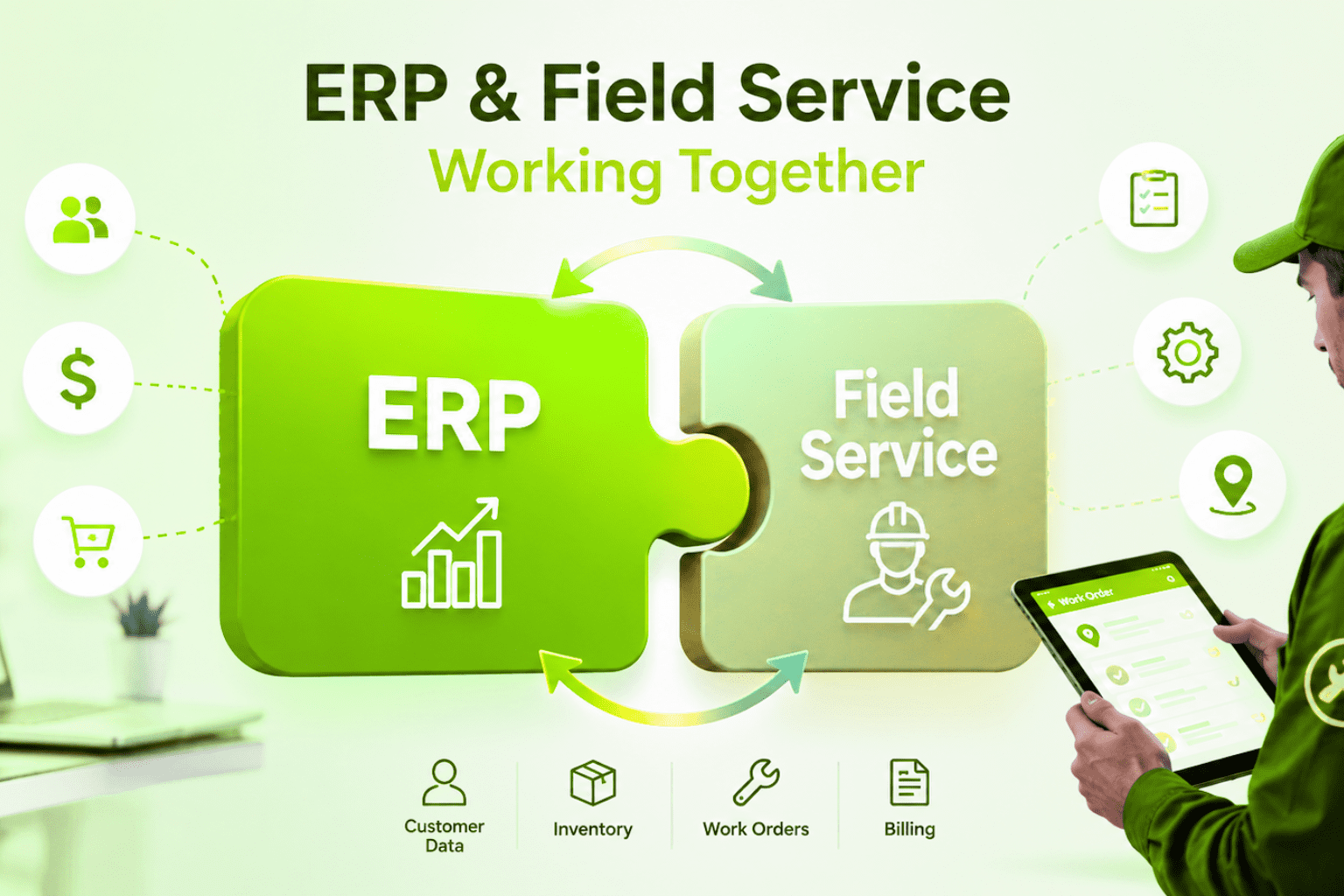

Understanding the Difference for Machine Centric Service Organizations
Organizations responsible for maintaining machines and technical systems depend on software platforms to manage maintenance, service interventions, and operational coordination. Over the past decades, two categories of software have become widely used in these environments. One is Computerized Maintenance Management Systems, commonly referred to as CMMS. The other is Field Service Management software, often abbreviated as FSM.
Although both categories relate to maintenance and service operations, they were designed with different operational priorities. Understanding the distinction between CMMS and FSM platforms helps organizations choose the system that matches their operational structure.
This distinction becomes particularly important for companies that install, maintain, inspect, or repair machines across multiple customer locations. These organizations often operate large installation bases and coordinate teams of technicians working in the field. Their service activities involve not only maintenance tracking but also technician planning, work order execution, customer communication, and service documentation.
In these environments, the difference between CMMS and FSM platforms becomes very clear.
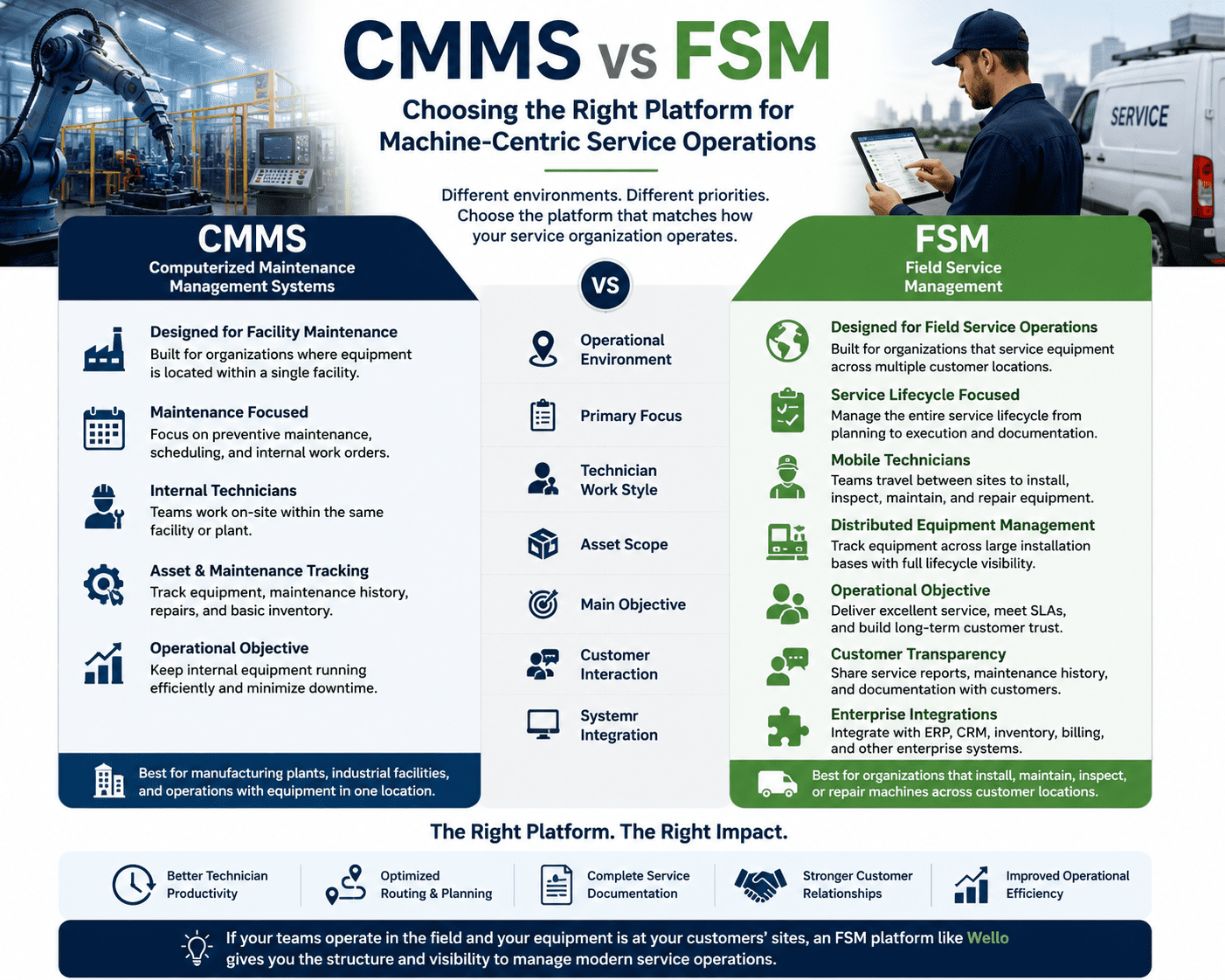
CMMS vs FSM platform comparison for service teams
The origins of CMMS systems
CMMS platforms were originally developed for organizations that manage maintenance within a fixed facility. Manufacturing plants, industrial production lines, and large infrastructure facilities needed tools to schedule maintenance tasks and record equipment repairs.
The objective of CMMS systems was to help maintenance teams keep equipment running within a controlled environment.
Within these facilities, machines typically remain located in the same building or production area. Maintenance teams operate on site, and service interventions are scheduled internally.
CMMS platforms were therefore designed to manage maintenance schedules, asset records, and internal maintenance work orders.
Typical CMMS capabilities include:
- Asset registers listing machines and equipment
- Preventive maintenance scheduling
- Maintenance work orders for internal technicians
- Basic parts inventory tracking
- Maintenance history and repair records
For facility based maintenance teams, this structure works well. The platform focuses on keeping internal equipment operational.
However, when service operations move beyond a single facility and technicians begin traveling to multiple customer locations, additional operational complexity appears.
The operational scope of field service management
Field Service Management software was developed to support organizations that perform service activities outside of a single facility.
Instead of maintaining machines within one plant, field service organizations manage equipment installed at customer locations. Technicians travel between sites to perform inspections, repairs, and maintenance interventions.
These organizations must coordinate technician schedules, travel routes, service contracts, and customer communication.
FSM platforms were designed to support this broader operational environment.
Rather than focusing only on maintenance tracking, FSM systems manage the entire lifecycle of service operations.
This includes:
- Work order management for field interventions
- Technician planning and dispatching
- Customer communication and service documentation
- Equipment lifecycle tracking across installation bases
- Service contracts and service level agreements
- Mobile applications for technicians
The focus of FSM software is therefore not limited to maintenance management. It extends to the full operational coordination of field service activities.
Differences in operational environment
The most significant difference between CMMS and FSM platforms lies in the operational environment they are designed to support.
CMMS systems assume that maintenance teams operate within a single facility. Equipment remains within that location, and technicians perform maintenance tasks within the same operational environment.
FSM platforms assume that technicians operate across distributed locations.
Machines may be installed in factories, buildings, industrial sites, or infrastructure environments owned by customers. Service providers must travel to these locations to perform their work.
This difference changes how software must manage operations.
Field service organizations must coordinate technician availability, travel time, service priorities, and customer communication. These elements are not central to traditional CMMS systems.
FSM platforms therefore include planning and dispatch capabilities that allow organizations to manage service teams operating across large geographic areas.
Work order execution in CMMS and FSM
Both CMMS and FSM systems include work order functionality, but the role of work orders differs between the two platforms.
In CMMS systems, work orders are typically generated for internal maintenance tasks within a facility. Maintenance managers schedule work orders according to preventive maintenance plans or repair requirements.
Technicians complete these tasks within the facility and document the results.
In FSM platforms, work orders represent operational instructions for field technicians.
Each work order contains information about the customer location, the equipment to be serviced, the tasks to be performed, and the service documentation required.
Because technicians operate outside the organization’s facility, the work order must also support coordination between planning teams, technicians, and customers.
FSM work orders therefore integrate with planning systems, mobile technician applications, and service reporting tools.
Technician mobility and planning
Technician mobility is one of the defining differences between CMMS and FSM platforms.
In facility maintenance environments, technicians work within a fixed location. Maintenance managers assign tasks based on internal schedules.
Travel planning is rarely a factor.
In field service environments, technicians travel between multiple sites during the day.
Planning teams must coordinate technician assignments based on location, skill requirements, service priority, and travel time.
FSM platforms include planning and dispatch systems designed to manage this complexity.
Planners can assign work orders to technicians according to availability and proximity to service locations.
Route optimization tools may help reduce travel time between service visits.
These capabilities allow service organizations to coordinate large technician teams operating across wide geographic areas.
Equipment lifecycle management
Another important difference between CMMS and FSM platforms relates to equipment lifecycle management.
CMMS systems track equipment installed within a facility. Maintenance history is recorded primarily for internal operational purposes.
FSM platforms track equipment installed across customer sites.
Service organizations often maintain thousands of machines distributed across multiple locations. Each machine requires maintenance records, service documentation, and inspection reports.
FSM platforms therefore maintain detailed asset lifecycle records.
Each piece of equipment may have its own service history, parts replacements, inspection documentation, and service contract information.
Technicians accessing work orders can review this history before performing maintenance interventions.
This lifecycle visibility is essential for organizations responsible for maintaining machines across large installation bases.
Customer interaction and service transparency
Customer interaction is another area where FSM platforms differ significantly from CMMS systems.
CMMS platforms are primarily designed for internal maintenance teams. Customer communication is not a central feature.
In contrast, field service organizations operate in direct relationship with customers.
Customers depend on service providers to maintain equipment that supports their operations.
FSM platforms therefore include tools that support customer interaction.
These may include customer portals where clients can view service reports, maintenance history, and scheduled interventions.
Service documentation such as inspection reports and signed work orders can be shared with customers through the platform.
This transparency strengthens service relationships and allows customers to track maintenance activities performed on their equipment.
Integration with operational systems
Both CMMS and FSM platforms may integrate with other enterprise systems, but the scope of integration differs.
CMMS systems often connect with inventory systems or facility management platforms.
FSM systems typically integrate with ERP systems that manage financial operations, inventory accounting, and customer records.
Because field service activities involve billing, service contracts, and parts consumption, ERP integration becomes important.
FSM platforms can synchronize customer data, parts usage, and service reports with ERP systems to ensure that financial records remain aligned with operational activity.
This integration allows organizations to connect field service operations with broader enterprise systems.
When CMMS systems are appropriate
CMMS platforms remain effective for certain operational environments.
Organizations managing maintenance within a single facility may find CMMS systems well suited to their needs.
Examples include manufacturing plants, industrial production lines, or infrastructure facilities where maintenance teams operate within the same location.
In these environments, the primary objective is maintaining equipment reliability within a controlled environment.
CMMS platforms provide the scheduling and maintenance tracking tools required for these operations.
When FSM platforms are required
Field service organizations operate under very different conditions.
Technicians travel between customer locations. Equipment is distributed across many sites. Service interventions must be planned, documented, and communicated with customers.
These organizations require platforms capable of managing the full service lifecycle.
FSM platforms provide the tools required for this operational model.
They support technician planning, work order execution, equipment lifecycle tracking, service documentation, and customer communication.
Platforms such as Wello are designed specifically for organizations that install, maintain, inspect, or repair machines across large installation bases.
These platforms provide the operational structure required to coordinate technicians, manage service contracts, and maintain transparent documentation of service activities.
Choosing the right platform for service operations
Selecting the appropriate software platform depends on the operational structure of the organization.
If maintenance occurs within a single facility and technicians operate internally, a CMMS system may provide the required functionality.
If technicians operate across multiple customer sites and service activities include maintenance, repair, inspections, and service contracts, a field service management platform becomes essential.
Understanding this distinction helps organizations select systems that support their operational workflows effectively.
For companies managing machines across distributed environments and coordinating teams of field technicians, FSM platforms provide the structure required to manage modern service operations.