

Improving Service Operations Through Data Analysis and Automation
Service organizations responsible for maintaining machines operate in environments where large amounts of operational data are generated every day. Technicians perform inspections, replace components, record measurements, and document observations. Planning teams coordinate interventions while responding to preventive maintenance schedules and unexpected incidents.
Over time this operational activity produces a detailed record of how machines behave and how service teams operate.
Historically, most of this information remained stored within service reports or operational systems without being analyzed in depth. Managers could review individual reports, but identifying broader patterns required significant effort.
Artificial intelligence now provides new possibilities for analyzing this operational data. When service information is structured and accessible, AI systems can examine historical service records, parts usage, inspection results, and service reports to identify patterns that may not be immediately visible to human operators.
AI powered maintenance does not replace technicians or service expertise. Instead, it assists service organizations by analyzing operational information and presenting insights that support better decisions.
Platforms such as Wello incorporate AI capabilities that help organizations understand service patterns, improve planning decisions, and analyze visual documentation generated during service interventions.
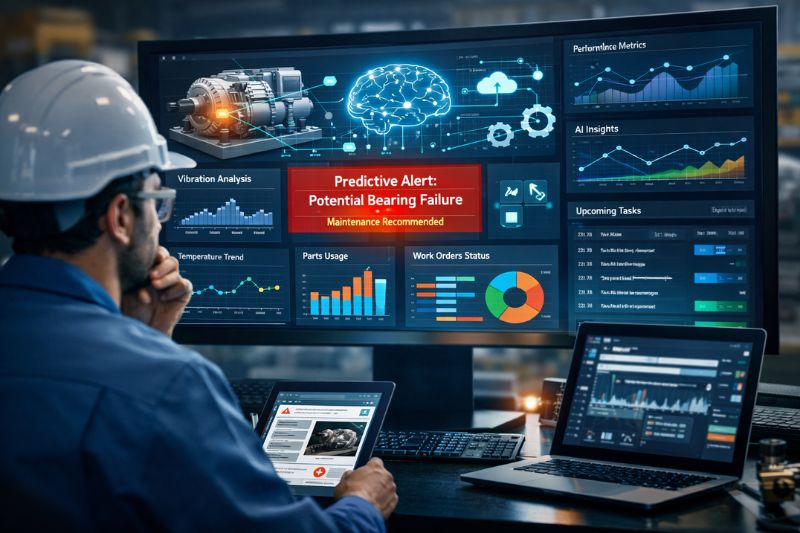
AI-driven maintenance monitoring station
The growing role of data in maintenance management
AI insights from service reports and inspections
Service reports often contain valuable observations recorded by technicians during maintenance visits.
Technicians may describe unusual equipment behavior, record measurement values, or document components showing signs of wear.
When these reports remain stored only as individual documents, the information they contain may remain difficult to analyze systematically.
AI powered analysis allows service platforms to examine large collections of service reports simultaneously.
Natural language processing techniques can analyze technician notes and identify recurring themes.
For example, the system may detect that certain equipment models frequently experience similar issues after a particular number of operating hours.
Inspection measurements recorded over time may also reveal trends indicating gradual performance degradation.
By identifying these patterns, AI systems can alert service organizations to emerging risks.
Technicians and managers can then investigate potential issues before equipment failures occur.
Supporting predictive maintenance strategies
Predictive maintenance aims to anticipate equipment failures before they happen.
Instead of relying only on fixed preventive maintenance intervals, predictive strategies analyze operational data to determine when components are likely to fail.
Artificial intelligence plays an important role in enabling these strategies.
By analyzing service history, parts replacements, inspection results, and operational measurements, AI systems can estimate the probability of future equipment issues.
For example, if historical data shows that certain components typically fail after a specific period or operating condition, AI models can identify machines approaching similar conditions.
Service organizations can then schedule maintenance interventions before the failure occurs.
This approach improves equipment reliability while reducing unexpected service incidents.
Predictive maintenance therefore complements preventive maintenance programs by providing additional insight into equipment condition.
Improving planning through AI analysis
Planning technicians efficiently is one of the most complex operational tasks within service organizations.
Planners must consider technician availability, travel distance, equipment location, required skills, and service priorities simultaneously.
Artificial intelligence can assist planning teams by analyzing historical operational data.
For example, AI systems can examine travel patterns, technician workload, and intervention durations.
Based on this analysis, the system can suggest optimal scheduling options for upcoming work orders.
If a planner needs to assign a technician to a specific intervention, the AI system may recommend technicians with the appropriate skills who are already operating in nearby areas.
This assistance does not replace the planner’s decision making. Instead, it provides recommendations that help planners evaluate scheduling options more efficiently.
AI assisted planning helps service organizations improve technician utilization while reducing travel time.
Analyzing visual documentation through AI image recognition
Technicians frequently capture photographs during service interventions.
These images may document equipment conditions, component wear, installation configurations, or inspection results.
Traditionally these images remain attached to service reports but are rarely analyzed systematically.
AI image recognition technologies allow service platforms to examine these images automatically.
For example, AI systems may detect patterns in job photos that indicate potential issues.
Images showing corrosion, component wear, or abnormal conditions may be flagged for further review.
Over time AI systems can learn from large collections of service images.
This capability helps service organizations identify visual indicators of equipment problems earlier.
Technicians and engineers can review flagged images and determine whether preventive interventions are required.
AI driven operational intelligence
Beyond analyzing individual service records, AI systems can also provide broader operational insight.
By combining information from multiple data sources, AI platforms can analyze how service operations perform across the organization.
This may include examining technician productivity, service demand patterns, and maintenance outcomes.
For example, AI systems may identify that certain regions experience higher incident volumes or that certain equipment types require more frequent interventions.
These insights help managers understand where operational improvements may be required.
Resource allocation can be adjusted accordingly.
Maintenance programs may be refined to address recurring issues.
This analytical capability transforms service data into operational intelligence that supports strategic decision making.
Supporting technicians with contextual insights
AI powered systems can also assist technicians during service interventions.
When technicians access work orders, the platform may present relevant historical information or recommendations based on previous service activity.
For example, if similar equipment has experienced recurring issues, the system may suggest specific components for inspection.
This contextual insight helps technicians approach interventions with better preparation.
Instead of starting diagnostics without prior information, technicians can review historical patterns identified by the system.
This improves diagnostic accuracy and may reduce intervention time.
AI assistance therefore supports technician expertise rather than replacing it.
Maintaining human oversight in AI systems
While AI technologies provide valuable analytical capabilities, service organizations must maintain human oversight.
Maintenance decisions often require professional judgment based on technical expertise and operational experience.
AI systems should therefore function as decision support tools rather than automated decision makers.
Technicians and service managers remain responsible for evaluating recommendations generated by AI systems.
When AI analysis highlights potential risks or patterns, service teams can review the information and determine appropriate actions.
This collaborative approach ensures that AI insights complement human expertise.
Building the foundation for AI powered maintenance
The effectiveness of AI powered maintenance depends on the availability of structured operational data.
If service information remains fragmented across disconnected systems, AI models cannot analyze it effectively.
Service platforms such as Wello help organizations structure operational data by connecting work orders, equipment records, inspection reports, and parts usage within a unified system.
When this data is stored in a structured format, AI systems can analyze it more efficiently.
Organizations therefore build the foundation for advanced analytics by implementing structured service management systems.
AI as a tool for operational improvement
Artificial intelligence represents an important evolution in maintenance management.
By analyzing service data, operational records, and visual documentation, AI systems help service organizations identify patterns that support better decision making.
Platforms such as Wello incorporate AI capabilities that assist with predictive maintenance insights, planning recommendations, image analysis, and operational intelligence.
These tools help organizations understand how machines behave, how service teams operate, and where improvements may be required.
However, AI powered maintenance does not replace the expertise of technicians, planners, or engineers.
Instead, it provides analytical support that helps these professionals manage complex service environments more effectively.
For service organizations responsible for maintaining large installation bases of machines and technical equipment, AI technologies offer new opportunities to improve reliability, efficiency, and operational visibility.