The real problem is not Odoo
Many service companies start with Odoo because it is flexible and covers a wide range of business needs. It handles customers, pricing, accounting, and sales in one place. At first, this feels enough.
But as operations grow, something starts to break. Not in the system itself, but in how work moves through the business.
Jobs increase. Teams expand. More technicians are sent into the field. More equipment is installed and maintained. The gap between what happens in the field and what is recorded in the system becomes wider.
This is where most companies hit a wall.
The issue is not that Odoo is weak. The issue is that Odoo was never designed to manage real-time field execution at scale.
Wello and Odoo integration solutions
Where the gap actually appears
The first signs are subtle.
Technicians start calling the office for missing information. Work orders are updated late or incorrectly. Parts used on-site are not recorded properly. Service reports are delayed.
Then the financial impact starts to show.
Invoices are created days after the job is completed. Some billable hours are missed. Pricing inconsistencies appear. Teams spend time checking and correcting data instead of moving forward.
What is happening is simple.
The system managing the business is disconnected from the system where the work actually happens.
Field operations move faster than ERP systems
Field service operations are dynamic by nature.
Technicians adapt to real situations. Jobs change on-site. Equipment conditions are not always predictable. Decisions are made in the moment.
ERP systems like Odoo are structured. They are designed for control, validation, and consistency.
This creates a mismatch.
Field teams need speed and flexibility. ERP systems need structured and validated data.
Trying to force both into one system creates friction.
Why adding more processes does not fix the problem
When companies face these issues, the first reaction is often to add more internal processes.
More validation steps. More reporting requirements. More control layers.
But this does not solve the problem. It usually makes it worse.
Technicians spend more time on administrative tasks. Office teams spend more time checking data. The system becomes heavier, not more efficient.
The real solution is not more control. It is better alignment between systems.
The role of Field Service Management software
Field Service Management software is designed for execution.
It is built around how work actually happens in the field.
Technicians can access job details instantly. They can log time, parts, and notes directly on-site. Service reports are generated as the work is completed.
This removes the gap between action and data capture.
Instead of reconstructing what happened after the job, the system captures it as it happens.
Why integration matters more than the tools themselves
Having both Odoo and FSM software is not enough.
The value comes from how they are connected.
Without integration, companies end up with two systems that still require manual coordination. Data is copied, checked, and corrected between them.
With proper integration, the flow becomes continuous.
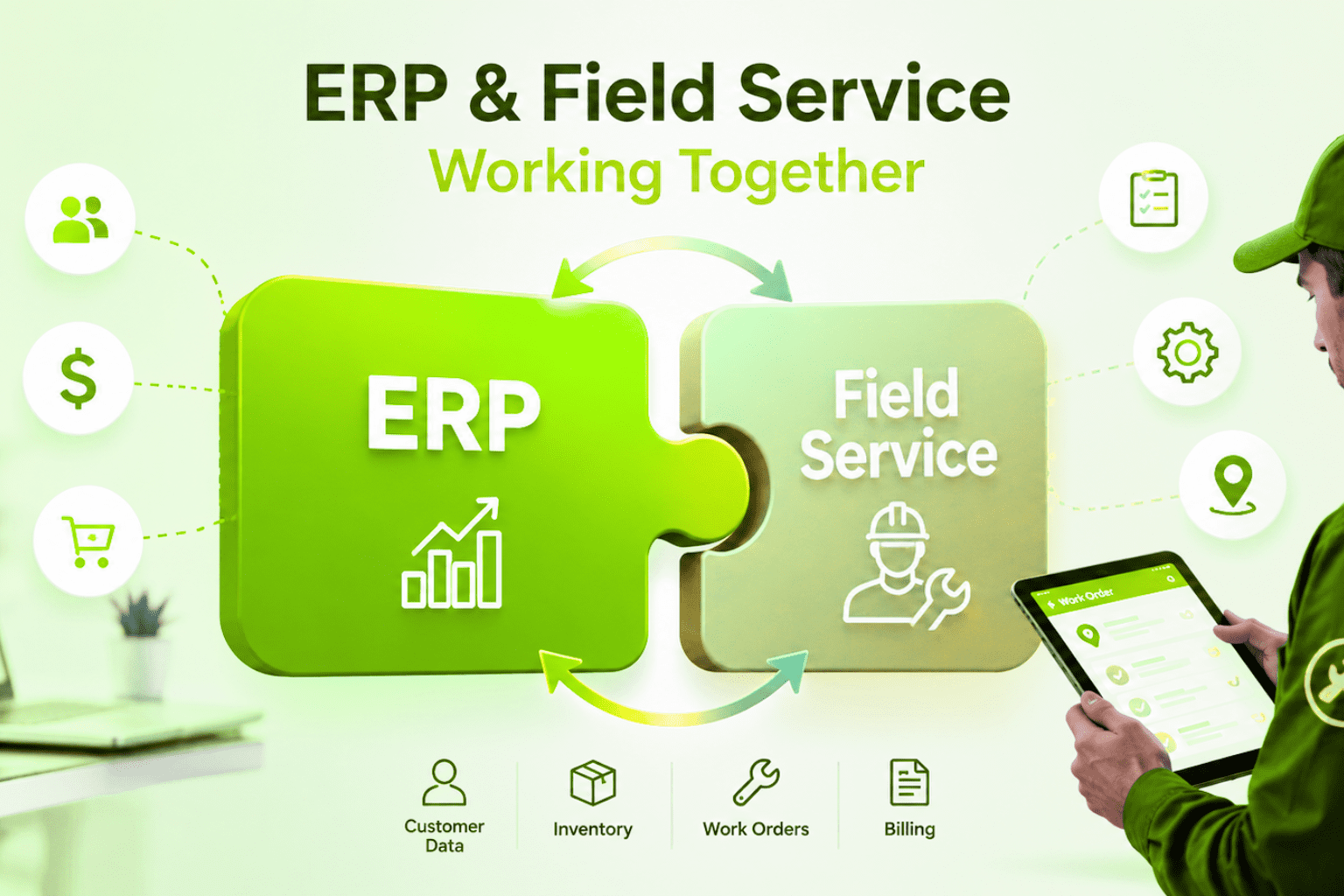
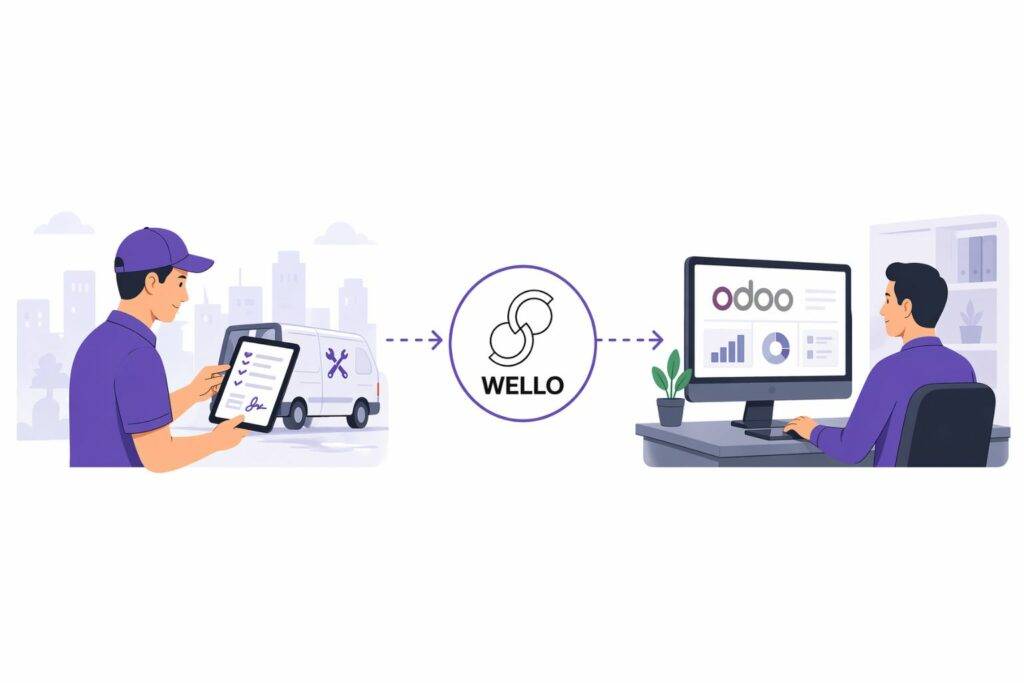
Customer and pricing data move from Odoo into the field system. Work execution happens in the FSM platform. Completed work flows back into Odoo for billing and financial tracking.
No duplication. No manual steps.
How Wello changes the operational flow
Wello is built to sit exactly at this intersection.
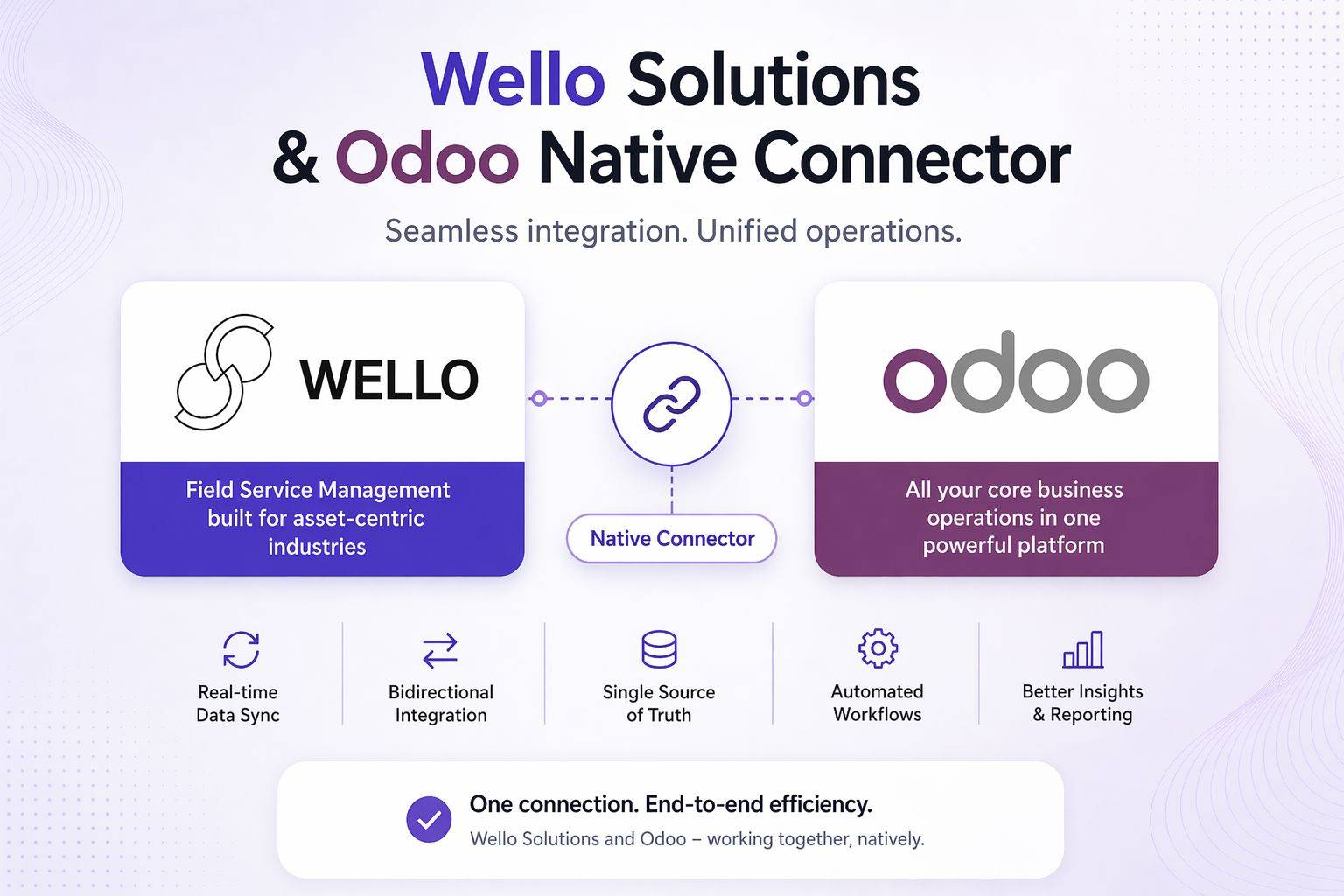
It manages the operational side of service work while connecting directly with Odoo for business processes.
You can explore the connector here: https://apps.odoo.com/apps/modules/15.0/wello-odoo-connector
Or see how the integration works in practice: https://wello.solutions/integrations/odoo/
In this setup, each system does what it is best at.
Wello handles planning, dispatching, execution, and reporting in the field. Odoo handles customer management, pricing, and invoicing.
The integration ensures that everything stays aligned automatically.
What changes once systems are aligned
The difference is not just technical. It changes how the business operates.
Work orders are completed and instantly available for billing. There is no delay between execution and revenue.
Technicians no longer rely on incomplete or outdated information. They work with accurate data in real time.
Finance teams no longer wait for reports or manual inputs. They receive structured data directly from completed work.
Managers gain visibility into operations without needing to ask for updates.
The entire organization becomes more responsive.
The impact on growth
Scaling a service business is not just about getting more customers. It is about handling more work without increasing friction.
When systems are disconnected, growth creates more complexity. More jobs mean more manual work, more errors, and more delays.
When systems are connected, growth becomes manageable.
Processes remain stable even as volume increases. Data flows automatically. Teams focus on execution instead of coordination.
This is what allows companies to scale without losing control.
A shift from reactive to structured operations
Without integration, companies operate reactively. They fix issues after they happen. They correct data after it is entered. They resolve inconsistencies after they appear.
With integrated systems, operations become structured.
Data is captured correctly from the start. Processes run automatically. Issues are reduced before they happen.
This shift is what separates companies that struggle with growth from those that handle it smoothly.
Who this approach is for
This model is not for every business.
It is designed for companies that depend on field operations.
Companies that install, maintain, or repair equipment. Teams that work across locations. Businesses that manage multiple jobs every day.
For these companies, the connection between field execution and business systems is not optional.
It defines how efficiently they operate.
Final thought
Odoo remains a strong system for managing business processes. It is not the problem.
The challenge is expecting it to handle field execution at scale.
Field operations require a different approach. They require tools designed for real-world execution, connected to systems that manage structure and finance.
When these systems are aligned, the business runs differently.
Work flows faster. Data becomes reliable. Revenue cycles shorten. Teams spend less time fixing problems and more time delivering service.
That is where real operational value is created.