

Supporting Technicians With Mobile Tools for Service Operations
Technicians are the central actors in field service operations. They travel to customer locations, inspect machines, perform maintenance, repair equipment, and document the work that has been completed. Every service intervention depends on their ability to access information, perform technical tasks, and report results accurately.
For many years technicians relied on paper documents or basic digital tools to manage their work. Work orders might be printed and carried to customer sites. Service reports were written manually and later entered into office systems. Photos and measurements were recorded separately and attached to reports later.
While this approach allowed service operations to function, it created inefficiencies. Technicians often lacked immediate access to equipment history. Service reports could be incomplete or delayed. Administrative teams had to reenter information into operational systems.
Mobile field execution applications were developed to address these challenges.
By providing technicians with direct access to service platforms through mobile devices, field execution apps allow technicians to receive work orders, access equipment history, record service information, and complete documentation while working on site.
Platforms such as Wello provide mobile service applications that connect technicians directly with operational systems, ensuring that service activities remain structured and transparent.
The operational role of technicians
Technicians perform the majority of operational tasks in field service organizations.
Their responsibilities include several types of activities.
Performing preventive maintenance inspections
Diagnosing equipment problems
Replacing defective components
Testing systems after repair
Documenting service interventions
Each of these tasks requires access to technical information and documentation tools.
For example, technicians may need to review the service history of a machine before beginning diagnostics. They may need to follow inspection procedures defined by maintenance guidelines. They may also need to record measurements or photographs as part of the service report.
Without mobile access to operational systems, technicians must rely on printed documentation or verbal communication with office teams.
Mobile field execution apps allow technicians to perform these tasks within a structured digital environment.
Accessing work orders in the field
Work orders represent the operational instructions for technicians.
Each work order contains information about the equipment, the location of the intervention, and the tasks that must be completed.
Field execution applications allow technicians to access their assigned work orders directly from mobile devices.
Technicians can view upcoming assignments, review intervention details, and navigate to customer locations.
This eliminates the need for printed work orders or manual coordination with dispatch teams.
Because the mobile application connects directly with the service platform, technicians receive real time updates when schedules change.
If planners assign a new work order or adjust an existing appointment, the technician can see the update immediately.
This improves coordination between office teams and field personnel.
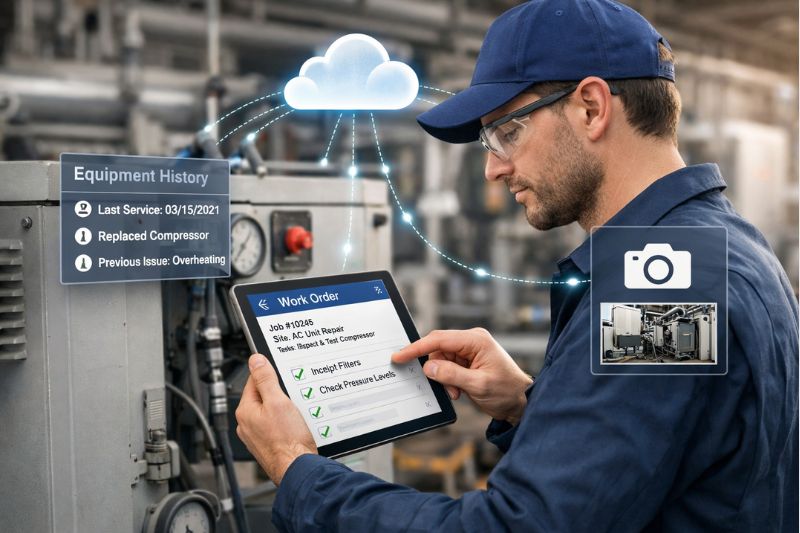
Technician in action with mobile app
Accessing equipment history and technical context
Before performing maintenance or repairs, technicians often need to understand the history of the equipment they are servicing.
Equipment records may contain information such as installation details, previous service interventions, component replacements, and inspection results.
Field execution applications provide technicians with access to this information directly within the work order interface.
By reviewing equipment history before starting the intervention, technicians gain valuable context.
For example, if a particular component has failed several times in the past, the technician can inspect that component carefully during the visit.
Access to service history also helps technicians understand the configuration of the equipment and previous maintenance procedures.
This preparation improves diagnostic accuracy and reduces time spent investigating issues.
Completing inspection forms and checklists
Many service interventions require technicians to follow structured inspection procedures.
Preventive maintenance visits often include specific tasks that must be completed in a defined sequence.
Inspection checklists ensure that technicians verify all required components and measurements during the intervention.
Field execution apps allow these checklists to be integrated directly into work orders.
Technicians can complete inspection tasks step by step while recording results within the mobile application.
Measurement values can be entered directly into the system. Observations can be recorded through notes or structured form fields.
This structured documentation ensures that maintenance procedures remain consistent across technicians and service teams.
It also ensures that inspection results remain stored within the equipment record for future reference.
Capturing service documentation on site
Accurate documentation is essential for service operations.
Service reports provide evidence that maintenance activities have been completed and help maintain transparency with customers.
Field execution apps allow technicians to capture service documentation while working on site.
Technicians can attach photographs showing equipment conditions, record measurement results, and write technical observations.
This information becomes part of the work order documentation.
Because the documentation is recorded immediately during the intervention, the risk of missing information is reduced.
Administrative teams no longer need to request additional details after technicians return from the field.
The completed work order already contains the relevant service information.
Registering parts used during interventions
Technicians frequently replace components as part of maintenance or repair activities.
Field execution apps allow technicians to register these parts directly within the work order.
The technician can select the component from the parts catalog and record the quantity used.
This information becomes part of the service report and remains linked to the equipment history.
Parts registration also supports inventory management.
When parts usage is recorded within the work order, the system can update stock levels automatically.
This ensures that inventory records remain accurate and that warehouse teams can replenish parts when necessary.
Recording labor time and service activity
Service organizations often track labor time associated with work orders.
Technicians may record travel time, time spent performing the intervention, and time required for documentation.
Field execution apps allow technicians to register these time entries directly within the mobile application.
This information supports several operational processes.
Managers can analyze technician workload and productivity. Service contracts that include hourly billing can use the recorded time data for invoicing. Planning teams can evaluate how long different types of interventions typically require.
Recording labor time during the intervention ensures that the data remains accurate and consistent.
Completing service reports and collecting signatures
Once a service intervention is completed, technicians typically produce a service report summarizing the work performed.
Field execution applications allow technicians to generate these reports directly within the mobile platform.
The report includes information recorded during the intervention, including inspection results, parts replacements, and technician observations.
Customers may review the report on site and confirm the completion of the work.
Digital signature functionality allows customers and technicians to sign the report directly on the mobile device.
This signed report becomes part of the permanent service documentation stored within the platform.
Customers can later access the report through customer portals or service documentation systems.
Working in environments with limited connectivity
Field service technicians often operate in environments where internet connectivity may be limited.
Industrial facilities, remote installations, or underground locations may not provide reliable network access.
Field execution applications must therefore support offline operation.
Technicians should be able to access work orders, complete forms, and record service documentation even when connectivity is unavailable.
Once the device reconnects to the network, the application can synchronize the recorded data with the central service platform.
This capability ensures that technicians can continue working without interruption regardless of connectivity conditions.
Improving collaboration between field and office teams
Field execution applications improve communication between technicians and office teams.
Planners and support staff can view work order progress in real time.
When technicians update the status of an intervention or submit documentation, the information becomes visible to office teams immediately.
This visibility improves coordination.
Planners can see when interventions are completed and schedule follow up tasks if necessary.
Support teams can respond to customer inquiries using the latest information recorded by technicians.
The mobile application therefore acts as a bridge between field activity and operational management systems.
Supporting large scale service organizations
For service organizations operating across multiple regions, field execution apps provide a consistent operational environment for technicians.
Regardless of location, technicians follow the same procedures for receiving work orders, documenting service activities, and submitting reports.
This consistency improves service quality across the organization.
Managers can trust that documentation remains structured and that operational data remains consistent across teams.
Field execution applications therefore play a critical role in maintaining operational standards as organizations grow.
Enabling efficient and transparent service execution
Field execution applications transform the way technicians interact with service management systems.
Instead of relying on paper documentation or disconnected tools, technicians perform their work within a structured digital environment.
Work orders, equipment history, inspection procedures, parts registration, and service documentation remain connected within the same platform.
Platforms such as Wello provide mobile service applications that connect technicians directly with operational service systems.
This integration ensures that service activities remain visible, documented, and aligned with operational processes.
For service organizations responsible for maintaining machines and technical equipment, field execution apps provide the tools required to perform service interventions efficiently while maintaining accurate operational records.