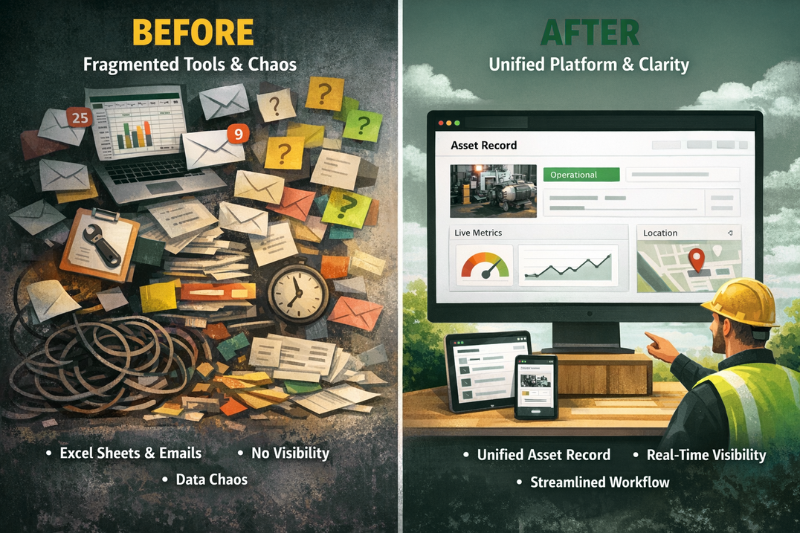
An enterprise service platform addresses this problem by creating a single operational environment where equipment, service activities, contracts, technicians, and documentation remain connected.
Wello was developed with this objective. The platform structures the operational backbone of organizations that install, maintain, inspect, or repair machines and technical equipment.
Instead of focusing only on scheduling tasks, the system organizes the entire lifecycle of service activity around assets.
Every machine becomes a structured record within the system. Installation data, maintenance plans, inspection forms, work order history, and parts usage remain connected to that record.
This structure allows service organizations to maintain a consistent operational memory. When technicians arrive on site they can access the history of previous interventions, inspection results, and replaced components.
Planning teams gain visibility into technician availability, service commitments, and maintenance schedules. This helps them coordinate interventions more efficiently across regions.
Managers gain access to operational data that reflects the real state of service delivery rather than incomplete or delayed reports.
Over time this structure becomes essential as organizations scale.
Service organizations with dozens or hundreds of technicians often operate across multiple branches or regions. Equipment may be installed in thousands of customer locations. Contracts define response times and maintenance obligations.
Managing this complexity requires a system that connects all elements of service operations.
An enterprise service platform provides this structure.
Within Wello, work orders act as the operational events that connect technicians, equipment, and service activities. Each work order captures the context of an intervention.
Technicians document inspections, record used parts, capture photos, and collect digital signatures. These details remain linked to the equipment and the service contract.
This structure creates a continuous service history.
Over time the accumulated data allows organizations to understand how equipment performs, which components fail most often, and how service teams operate across regions.
Planning becomes easier because historical travel times and technician workloads become visible. Service contracts remain connected to maintenance schedules and SLA commitments.
Instead of rebuilding information before every audit or customer request, organizations can access complete documentation directly from the system.
The platform also connects service operations with financial systems.
Many service organizations rely on ERP systems such as SAP, Microsoft Business Central, or Exact for accounting, billing, and procurement. However, these systems typically do not manage the operational complexity of field service.
Wello synchronizes relevant service data with these systems so that work performed in the field remains aligned with financial records.
Parts used during interventions can be recorded against inventory. Labor time can be prepared for billing. Contract conditions remain consistent across operational and financial systems.
This synchronization reduces manual reconciliation and improves accuracy in billing processes.
Another critical element of an enterprise service platform is technician execution.
Technicians require access to information while working on site. Service history, inspection checklists, parts catalogs, and documentation tools must be available directly on mobile devices.
The Wello mobile application allows technicians to execute work orders while capturing structured information during the intervention.
Forms guide inspection procedures. Photos and measurements can be recorded directly within the work order. Used parts can be registered immediately.
By capturing this information at the moment of service, organizations reduce the risk of incomplete reports or missing documentation.
This improves both service quality and operational transparency.
As organizations grow, service platforms also support operational coordination between departments.
Planning teams coordinate technician schedules. Helpdesk teams register service requests. Warehouse teams manage spare parts. Management teams analyze performance metrics.
A unified platform ensures that all these roles operate within the same system.
This reduces communication gaps between office teams and technicians in the field.
For example, when a helpdesk receives a service request, it can be converted into a work order that becomes visible to planners. The planner schedules the intervention and assigns a technician. The technician performs the work and records documentation.
Once completed, the work order remains stored with the equipment record.
Each step remains traceable within the system.
This structured approach becomes increasingly important in regulated industries where service documentation must be preserved for many years.
Organizations operating in energy systems, fire detection, industrial equipment, or water treatment often face strict compliance requirements. Inspections must be documented and certifications must remain accessible.
A structured service platform ensures that documentation remains connected to the equipment and service history.
When an audit occurs, organizations can retrieve the relevant records without reconstructing information from different systems.
The long term value of an enterprise service platform lies in the operational clarity it provides.
Instead of managing service operations through disconnected tools, organizations maintain a structured environment where machines, technicians, and service activities remain linked.
This improves planning, documentation, and operational transparency.
For organizations managing complex service environments, the ability to maintain this structure becomes essential for maintaining service quality as operations grow.
Enterprise service platforms therefore represent more than a scheduling tool. They form the operational backbone of modern service organizations that rely on machines and technical equipment to deliver value to their customers.
See how Wello structures your entire service operation around your equipment.
👉 Book a demo