

Planning Efficient Travel and Service Schedules
Service organizations that maintain machines across multiple customer locations face a common operational challenge. Technicians must travel between sites to perform inspections, repairs, and maintenance tasks. These sites may be located across cities, regions, or even different countries.
As installation bases expand and technician teams grow, coordinating travel becomes increasingly complex.
Without structured planning, technicians may spend a large portion of their working day traveling rather than performing service work. Inefficient routes increase fuel consumption, extend response times, and reduce the number of interventions that technicians can complete.
Route optimization helps service organizations address this challenge.
By organizing technician schedules and travel routes more effectively, organizations can reduce travel time, improve technician productivity, and deliver faster service to customers.
Field service platforms include route optimization capabilities that help planners coordinate technician activity across large geographic areas.
Understanding the complexity of technician travel
Technician travel involves more than simply assigning the closest technician to a job.
Planning teams must consider several factors when scheduling service visits.
Technician availability
Required technical skills for the intervention
Customer service commitments
Travel distance between locations
Traffic conditions and travel time
For organizations managing large installation bases, hundreds of service visits may need to be coordinated each week.
Planning these routes manually becomes difficult as technician teams expand.
Without route optimization tools, planners may spend significant time adjusting schedules and attempting to balance technician workloads.
Service platforms provide structured planning environments that allow these decisions to be made more efficiently.
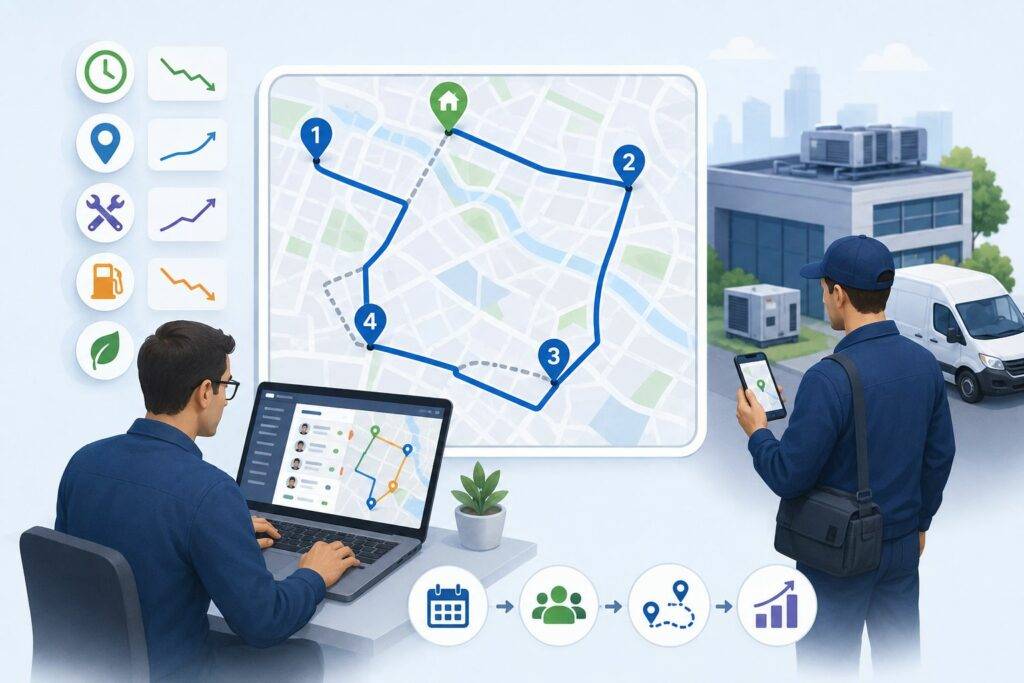
The impact of travel time on service productivity
Travel time has a direct impact on service productivity.
Every hour spent traveling between customer locations is time that technicians are not performing service work.
In organizations managing large technician teams, even small inefficiencies in route planning can accumulate quickly.
For example, if technicians spend one additional hour per day traveling unnecessarily, the impact across dozens of technicians becomes significant.
Reducing travel time allows technicians to perform more service interventions during the same working day.
Customers benefit from faster response times and more predictable service schedules.
Route optimization therefore contributes directly to both operational efficiency and service quality.
Planning technician schedules across multiple locations
Service planners must coordinate technician schedules across a wide range of customer locations.
Machines may be installed in industrial facilities, technical buildings, warehouses, or infrastructure sites.
Maintenance visits must be scheduled according to preventive maintenance programs or customer service requests.
Route optimization helps planners organize these visits logically.
Instead of assigning work orders randomly, planning systems can group interventions by geographic proximity.
Technicians visiting a particular area can perform several service tasks within the same region during the same day.
This reduces unnecessary travel and helps technicians complete more interventions efficiently.
Balancing technician skills and geographic location
Technician assignments must consider both geographic location and technical expertise.
Some service interventions require specialized knowledge or certifications.
For example, technicians servicing heating systems may require specific training related to combustion analysis. Technicians maintaining safety systems may need certification to inspect fire detection equipment.
Route optimization systems therefore consider technician skills when assigning work orders.
Planning systems identify technicians who possess the required expertise while also evaluating their proximity to the service location.
This ensures that the most appropriate technician performs the intervention while minimizing travel distance.
Balancing these factors improves both service quality and operational efficiency.
Managing urgent service requests
Service organizations often receive urgent requests when equipment failures occur.
Customers may report malfunctions that require immediate attention.
Planning teams must then insert these urgent work orders into technician schedules without disrupting the entire service plan.
Route optimization tools help planners adjust schedules dynamically.
The system can identify technicians operating near the service location who have availability within their schedule.
Planners can then reassign work orders or adjust routes to accommodate the urgent intervention.
This flexibility allows organizations to respond quickly to customer needs while maintaining efficient technician routes.
Supporting preventive maintenance programs
Preventive maintenance programs generate recurring service visits for machines installed at customer sites.
These visits must be scheduled according to defined maintenance intervals.
When installation bases include hundreds or thousands of machines, planning these visits manually becomes complex.
Route optimization tools help planners schedule preventive maintenance visits efficiently.
Machines located within the same geographic area can be grouped into service routes.
Technicians can perform multiple maintenance visits within the same region during a single day.
This structured planning reduces travel time and ensures that preventive maintenance schedules remain consistent.
Reducing operational costs
Travel represents a significant operational cost for many service organizations.
Fuel consumption, vehicle maintenance, and technician travel time all contribute to the overall cost of service delivery.
Route optimization helps reduce these costs.
By minimizing unnecessary travel, organizations can reduce fuel consumption and vehicle wear.
Technicians spend more time performing service interventions and less time driving between locations.
This improves resource utilization and reduces operational expenses.
In addition, reduced travel contributes to lower environmental impact, which is becoming increasingly important for many organizations.
Improving service response times
Customers expect timely service when equipment problems occur.
Route optimization allows service organizations to respond more quickly to service requests.
Because technician schedules are organized efficiently, planners can identify technicians operating near the customer location.
Service visits can be scheduled sooner without requiring technicians to travel long distances.
Faster response times improve customer satisfaction and strengthen service relationships.
In industries where equipment reliability is critical, rapid response capabilities can be a major competitive advantage.
Integrating route optimization with service platforms
Route optimization functions most effectively when integrated directly into field service platforms.
Planning systems already manage work orders, technician schedules, and equipment locations.
Route optimization tools use this information to recommend efficient travel routes.
For example, the system may analyze work order locations and suggest the best sequence for technicians to visit multiple sites.
Historical travel times can also be used to estimate how long journeys between locations typically require.
These insights help planners create realistic schedules that account for both service duration and travel time.
Platforms such as Wello provide planning assistants and route optimization tools that support this process.
Planners maintain control over technician assignments while benefiting from system recommendations.
Supporting large technician teams
As technician teams expand, route optimization becomes increasingly important.
Organizations managing dozens or hundreds of technicians must coordinate a large number of service visits each day.
Manual planning methods struggle to handle this level of complexity.
Service platforms provide centralized planning environments where route optimization tools can analyze technician schedules and service locations.
Planners gain visibility into technician availability and travel routes across the entire team.
This allows organizations to coordinate large service operations while maintaining efficient travel patterns.
Building efficient service operations
Route optimization plays an important role in modern field service management.
Technicians must travel between customer locations to maintain machines and technical equipment. Efficient route planning ensures that travel time remains controlled and that technician productivity remains high.
By organizing service visits according to geographic proximity, technician expertise, and service priorities, route optimization improves both operational efficiency and customer satisfaction.
Field service platforms such as Wello integrate route planning with technician scheduling and work order management.
This allows service organizations to coordinate large technician teams while maintaining visibility over service operations.
For companies responsible for maintaining machines across large installation bases, route optimization becomes an essential component of efficient service delivery.