
A Practical Guide for Service Directors and Operations Leaders
Organizations responsible for installing, maintaining, and repairing machines operate in environments where service operations must remain structured and reliable. Technicians perform inspections, repairs, and preventive maintenance across many customer locations. Equipment must be maintained over many years, and service documentation must remain accessible for operational and regulatory purposes.
As installation bases grow and technician teams expand, managing service operations through spreadsheets, disconnected systems, or outdated software becomes increasingly difficult.
Field service management software provides the structure required to coordinate technicians, manage work orders, maintain equipment records, and document service activities.
However, choosing the right platform requires careful evaluation. Your service team should select software that aligns with their operational complexity and long term growth.
Understanding the key capabilities of enterprise field service platforms helps organizations make informed decisions.
Choosing enterprise field service software
Understanding the operational needs of service organizations
Before selecting a field service platform, organizations must first examine how their service operations function.
Companies maintaining machines typically manage several operational components simultaneously.
Technicians travel between customer locations to perform service interventions. Equipment records must be maintained for each installed machine. Preventive maintenance programs must be scheduled and executed consistently. Service documentation must remain accessible for customers and regulatory audits.
These operational requirements create a complex environment.
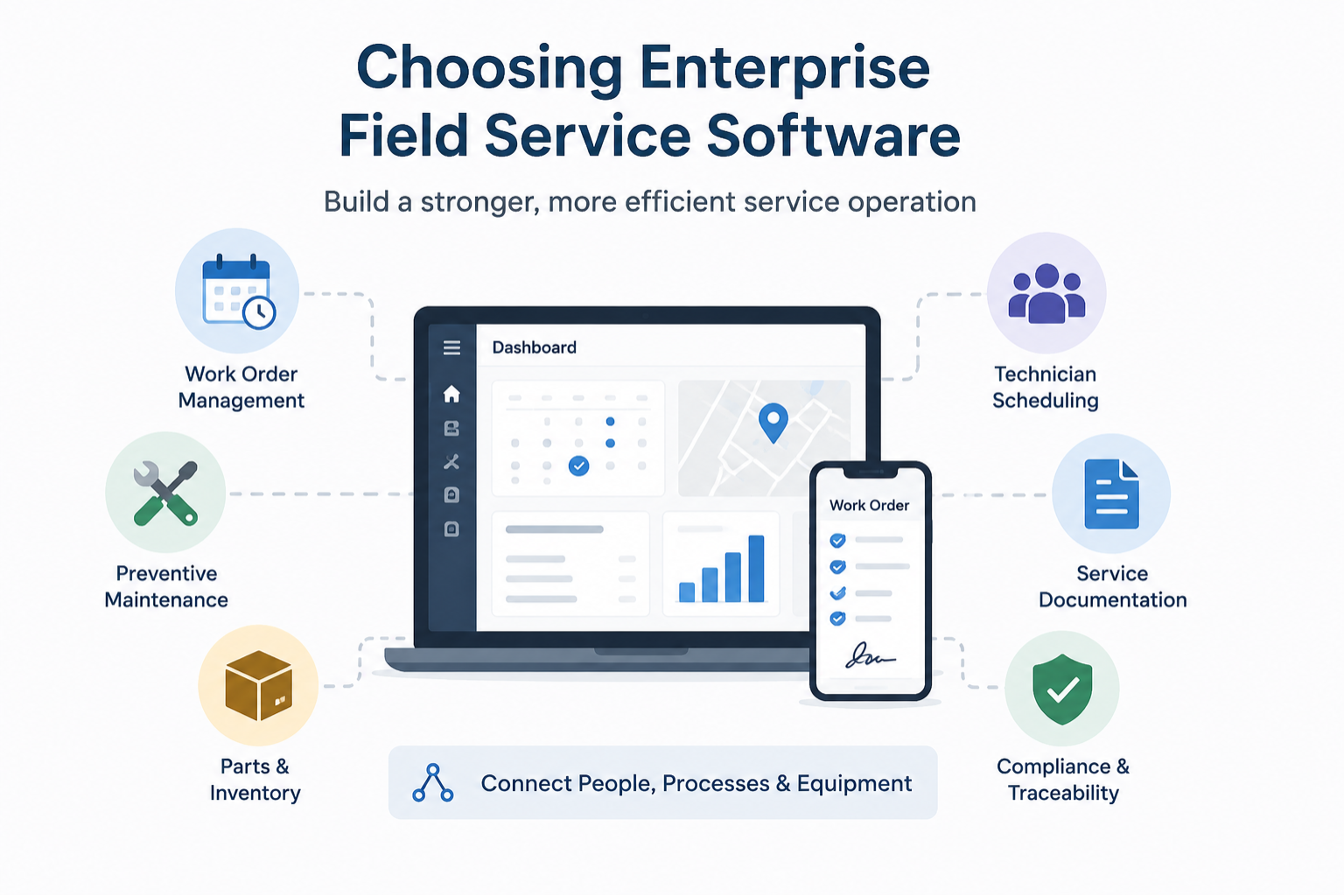
Your service platform should be the hub that keeps everyone and everything in sync.
A platform designed only for basic job scheduling may not provide the operational structure required for organizations managing large installation bases.
Understanding operational complexity helps organizations identify which capabilities are essential.
Managing equipment lifecycle information
For organizations maintaining machines, the installation base represents the core of service operations.
Every machine installed at a customer location must have a structured digital record.
These records contain information such as installation details, maintenance history, inspection documentation, and component replacements.
When technicians perform service interventions, the resulting documentation becomes part of this equipment history.
Field service platforms designed for equipment service environments maintain structured asset lifecycle records.
Technicians can review equipment history before performing maintenance. Service managers can analyze how machines behave over time. Customers can access documentation related to service activities performed on their equipment.
A platform that does not provide detailed asset lifecycle management may limit operational visibility.
Coordinating technician planning and dispatch
Technician coordination is one of the most challenging aspects of field service management.
Service teams must assign technicians according to several factors.
Technician availability
Technical skills required for the intervention
Customer service commitments
Travel distance between service locations
Enterprise field service platforms provide planning tools that allow service managers to coordinate technician activity efficiently.
Work orders appear within planning dashboards where dispatch teams can assign technicians based on availability and location.
Planning systems also help balance workloads across technician teams.
In organizations managing dozens or hundreds of technicians, planning capabilities become critical for maintaining efficient service operations.
Structuring work order execution
Work orders represent the operational instructions for technicians.
Each work order describes the service task that must be performed, the equipment involved, and the location of the intervention.
Enterprise service platforms allow work orders to be structured and documented throughout the service lifecycle.
Technicians receive work orders through mobile applications. They can review equipment history, follow inspection procedures, and record service documentation directly within the system.
Once the intervention is completed, the work order becomes part of the equipment record.
This structured execution ensures that service activities remain transparent and traceable.
Organizations evaluating field service platforms should ensure that work order functionality supports the full service workflow.
Supporting preventive maintenance programs
Preventive maintenance programs are fundamental for many equipment service organizations.
Machines must be inspected regularly to ensure reliability and compliance with operational standards.
Enterprise field service platforms allow preventive maintenance schedules to be configured for each machine or equipment type.
The system automatically generates work orders when maintenance interventions become due.
Planning teams can assign technicians to perform the required inspections.
Technicians follow structured checklists during the maintenance visit, and results become part of the equipment record.
Platforms that support automated maintenance scheduling help organizations maintain consistent service programs across large installation bases.
Providing mobile tools for technicians
Technicians working in the field require access to operational information while performing service interventions.
Mobile service applications allow technicians to receive work orders, access equipment history, record inspection results, and capture service documentation directly on site.
These applications eliminate the need for paper documentation or manual data entry after returning to the office.
Technicians can complete service reports, register parts usage, and collect customer signatures during the intervention.
Because information is recorded directly within the system, documentation remains accurate and accessible immediately.
Mobile field execution capabilities are therefore essential for organizations coordinating large technician teams.
Managing spare parts and inventory
Spare parts management is closely connected to maintenance operations.
During service interventions, technicians may replace components such as sensors, filters, valves, or mechanical parts.
Enterprise field service platforms allow technicians to record parts usage within work orders.
This information becomes part of the equipment history and supports inventory tracking.
When integrated with ERP systems, parts usage recorded during service interventions can update inventory records automatically.
Organizations evaluating service platforms should ensure that parts management capabilities align with their inventory processes.
Integrating service operations with enterprise systems
Field service operations rarely operate in isolation.
Organizations typically rely on ERP systems to manage financial operations, procurement, and inventory accounting.
Integration between the service platform and ERP systems ensures that operational and financial data remain aligned.
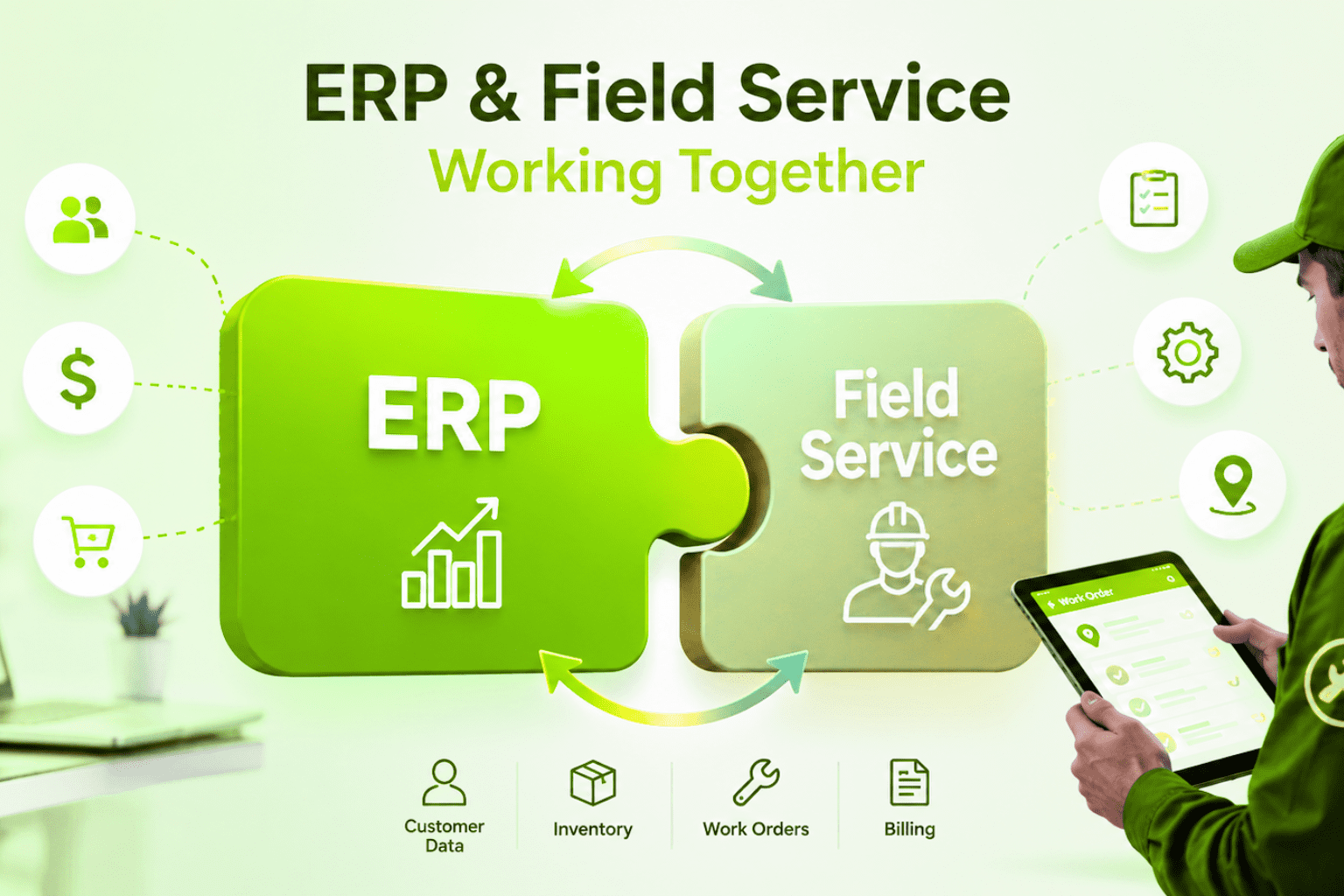
Customer records stored in ERP systems can synchronize with service platforms. Work order activity can support billing processes. Parts usage recorded by technicians can update inventory records.
These integrations reduce manual administrative work and improve data consistency across systems.
Service platforms designed for enterprise environments often provide flexible integration capabilities.
Maintaining service documentation and compliance records
Many service organizations operate in regulated environments where maintenance documentation must be retained for inspection or audit purposes.
Service platforms must therefore support structured documentation management.
Inspection reports, service records, photographs, and technician observations should remain connected to equipment records and work orders.
When audits occur, organizations must be able to retrieve documentation quickly.
Platforms that store documentation within the operational system help reduce the administrative effort associated with compliance verification.
This capability becomes particularly important for industries such as energy systems, safety equipment, water treatment, and industrial infrastructure.
Evaluating scalability and long term stability
Selecting field service software is a long term decision.
Service platforms become central systems within the organization.
Work orders, equipment records, service documentation, and technician coordination all depend on the platform.
Organizations should therefore evaluate whether the platform can support future operational growth.
Installation bases may expand. Technician teams may increase. Service operations may extend to new regions.
The platform must remain capable of supporting these changes.
Scalability, system reliability, and vendor stability become important factors during the evaluation process.
Choosing a platform designed for structured service environments helps ensure that the system continues to support operations as the organization evolves.
Building a structured digital service environment
Field service software plays a central role in modern equipment maintenance operations.
If your team maintains machines across multiple locations, you need one system that keeps technicians, planners, service managers, and equipment records connected.
Enterprise field service platforms provide this structure.
They allow organizations to manage installation bases, coordinate technicians, execute maintenance programs, document service interventions, and maintain transparent service relationships with customers.
Platforms such as Wello are designed for organizations that install, maintain, inspect, or repair machines and technical systems across large installation bases.
By connecting operational workflows with equipment lifecycle records and enterprise systems, field service platforms help organizations maintain reliable service operations while supporting long term growth.
Choosing the right platform is a big step toward building a service operation that can grow without getting harder to manage.