
Compare Wello and Salesforce Field Service. See differences in pricing, setup time, usability, mobile tools, integrations, and which fits field teams best.

Choosing between field service platforms can feel like a bigger project than actually improving your field operations. If you’re comparing Wello vs Salesforce FSM, you’re probably asking:
In this comparison, we’ll look at Wello (an FSM-first platform built for asset-centric service businesses) and Salesforce Field Service (an add-on in the wider Salesforce ecosystem).
We’ll compare pricing, features, ease of use, implementation, mobile experience, integrations, and support. We’ll also help you decide which fits your business today and as you grow. You’ll see that while Salesforce FSM shines for enterprises already deep in Salesforce, Wello is often the smarter, lower-risk choice for businesses and service companies that want powerful field service management without CRM lock-in.
| Criteria | Wello | Salesforce Field Service (FSM) | Winner |
| Starting price | Visit the pricing page | View the available pricing options here | Wello for conservative value |
| Implementation time | Typically 1–6 weeks, depending on business scale (FSM-first, simpler scope) | Often 3–6+ months, especially when integrating with existing Salesforce orgs and partners | Wello for faster time-to-value |
| Ease of use | ~9/10 because it is designed specifically for planners, technicians & service managers, and there’s therefore less configuration overhead | ~7/10 because it’s powerful, but it is frequently described as complex with a steep learning curve for non-Salesforce teams | Wello for a broader user range (less technical & highly technical teams) |
| Best for | All business sizes & mid-market service companies (HVAC, maintenance, technical services, installers) that need FSM-first operations control | Large organizations already invested in Salesforce CRM, with complex processes & IT resources | Highly contextual |
| Key strength | All-in-one FSM built for asset-centric service: work orders, contracts, planning, mobile, reporting | Deep Salesforce ecosystem integration and advanced scheduling | If your business prioritizes FSM first, then you should consider Wello. |
| Integration ecosystem | Native ERP/accounting integrations (Exact Online, SAP B1, AFAS, QuickBooks, Xero, Dynamics 365 BC, etc.) + connectors via Zapier/Make | Deep, native integration with Salesforce clouds + broad app marketplace | This is dependent on the current tools you integrate with for your day-to-day activities. With Wello, you can easily integrate with any software solution you currently use without the fear of being restricted to a particular ecosystem. |
| Customer support | Highly rated support with responsive onboarding and dedicated live assistance for teams | Good ecosystem of partners. Support is often routed via Salesforce + implementation partners | If you want a dedicated and fast support channel, Wello meets the criteria. |
| Free trial | Early access on request | No classic free trial for full FSM | Wello |
If you’re comparing Wello vs Salesforce FSM strictly from a field service management solution and not a full CRM stack perspective, Wello takes the edge.
Wello is a cloud-based field service management (FSM-first) platform built for asset-centric industries, which include companies offering services such as installation, maintenance, and repair. It centralizes customers, assets, work orders, planning, mobile execution, and reporting into one hub so you’re not juggling spreadsheets or various other tools.
Key ideas:
Plans are structured clearly with detailed price breakdowns, minimum user counts, and clear feature unlocks. You can see exactly what you get and what it costs.
Salesforce Field Service is a field service module that sits on top of the wider Salesforce platform. It’s designed for organizations that already use Salesforce CRM and want to extend it into scheduling, dispatch, work orders, and mobile field operations.
Core characteristics:
Salesforce FSM can be incredibly powerful at enterprise scale, but it comes with the Salesforce ecosystem premium in licensing, implementation, and ongoing administration.
For detailed pricing information, please refer to the official pages:
Pricing is just one piece of the puzzle. The real difference appears when you consider implementation speed, ongoing complexity, and predictability of costs.
Here’s why that matters:
If you’re actively searching for “Salesforce FSM alternative without CRM lock-in,” Wello is exactly that: a full-strength FSM platform without requiring a Salesforce subscription underneath.
Both tools cover the basics of field service:
The difference is where each platform goes deepest.
From your Wello feature matrix, plus public product info, Wello offers:
In other words, everything revolves around field service operations.
Salesforce FSM shines when you want:
However, a lot of that power depends on:
If you’re primarily focused on running a lean, efficient field service operation, Wello’s focused feature set can be more than enough without the overhead.
If you don’t have internal Salesforce expertise, you’re realistically looking at consulting costs plus longer timelines with Salesforce FSM.
Users reviewing Wello often highlight its clarity and ease of adoption by planners and technicians who are not “software people.”
Salesforce FSM, on the other hand, is described as:
If you want your technicians and dispatchers to adopt the tool quickly without weeks of training, Wello has the edge.
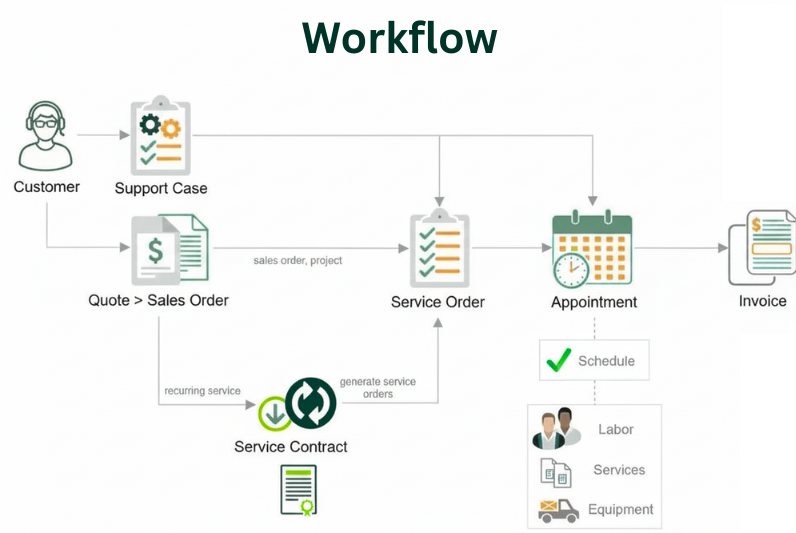
Both platforms offer a mobile app for technicians with offline capabilities and access to work orders, customer details, and job history.
Key differences in practice:
If your technicians are not “Salesforce power users” and you need them to go live fast, Wello’s mobile app is likely easier to roll out, train, and standardize.
Here’s where the “Standalone FSM vs CRM add-on” angle really matters.
Wello connects directly to many of the systems that matter most to service businesses:
This makes Wello a strong central operations hub that still plays nicely with your existing stack.
Salesforce FSM’s biggest integration advantage is obvious:
If Salesforce is already the heart of your business, that’s a huge plus.
But if Salesforce is not your system of record (or you’re not ready to move everything there), that strength can turn into vendor lock-in and higher long-term cost.
Question to ask yourself:
Do you want a field service tool that happens to integrate with your CRM (Wello), or a CRM that happens to have field service features (Salesforce FSM)?
If you prefer direct access to a product team that speaks field service, Wello has an advantage. If you prefer a large ecosystem of consulting partners and internal admins, Salesforce FSM fits that model.
Wello is likely the better fit if:
In short: Wello is the more streamlined, FSM-first choice for most growing and established service businesses.
Salesforce Field Service may be the right choice if:
In these edge-case scenarios, the ecosystem and scalability of Salesforce FSM can outweigh its cost and complexity.

If you strip away the brand names and focus on your reality as a service leader, the decision comes down to:
For most service businesses, Wello is:
Salesforce FSM remains a great fit if:
Field service is part of a large, multi-cloud Salesforce strategy
But if you’re looking for a field service software without CRM lock-in, Wello is often the simpler, lower-risk option for many asset-centric field service businesses.
Try Wello to experience how planning, work orders, and mobile execution feel in your own workflow.
You can also book a personalized demo where the Wello team will walk you through Wello FSM based on your actual processes, technician count, and tech stack.
You’ll get a first-hand view of exactly what you’d gain (and save) by choosing an FSM-first platform.
Yes, for most service business use-cases, Wello covers multi-site equipment management, preventive maintenance plans, service contracts & SLAs, skills-based scheduling and teams, etc.
If you need extreme, enterprise-grade customization across multiple business units and global Salesforce data structures, Salesforce FSM also has a broad configuration surface – but many service businesses never need that level of complexity.
Migration complexity depends on how deeply embedded Salesforce is in your organization. Typical steps:
For many field service teams, migration is a manageable project measured in weeks, not years, especially compared to implementing Salesforce FSM from scratch.
Both offer strong mobile apps with offline support and access to key job information.
However, user feedback suggests:
If technician adoption is a concern, Wello is likely easier to roll out successfully.
Yes. Both integrate well, but in different ways:
If your core stack is ERP + accounting + light CRM, Wello is often easier and cheaper to integrate. If your core stack is Salesforce-first, Salesforce FSM fits naturally.
Both offer solid support, but in different ways:
If you prefer a direct relationship with an FSM-focused vendor, Wello will feel more accessible.
Yes. Wello is used by organizations from small service businesses up to mid-market and larger companies. The main difference is that Wello scales as an FSM-first platform, whereas Salesforce FSM scales as part of a large CRM and enterprise platform.

Not a Wello Solutions user yet? Schedule your demo today to see how we can streamline your field service operations.

Wello’s simple pricing helps service businesses grow with clear, predictable plans—Starter, Professional, and Enterprise—all with AI included.
Learn more →
When running a field service business, time management is crucial for success and growth. Effective time management isn’t about managing time, but about managing yourself. Learning how to accomplish more in less time allows you to focus on what’s most important.
Learn more →
Field Service Management (FSM) software is a digital tool designed to help field service companies efficiently manage their staff, resources, and operations.
Learn more →Save time and minimize risk with the all-in-one tool offering a robust opеrations management solution
tailorеd for companies spеcializing in installation, maintеnancе, and rеpair sеrvicеs.







 Wello App.