Managing Long Term Maintenance Agreements and Service Commitments

For many service organizations, long term relationships with customers are built around service contracts. These agreements define how equipment will be maintained, inspected, and supported over time. Instead of responding only when a failure occurs, service providers take responsibility for maintaining machines through structured maintenance programs.

Service contracts therefore represent both an operational and a commercial foundation for organizations that install and maintain machines and technical equipment.

Customers rely on these agreements to ensure that their equipment remains reliable. Service providers rely on them to organize predictable maintenance activity and maintain long term customer relationships.

However, as installation bases grow and contract portfolios expand, managing service agreements becomes increasingly complex.

Organizations may operate hundreds of service contracts across multiple regions. Each contract may define different maintenance intervals, response commitments, pricing conditions, and documentation requirements.

Without structured systems, managing these obligations becomes difficult. Maintenance schedules may be missed. Service conditions may be applied inconsistently. Billing processes may become disconnected from the actual work performed.

Service contract management systems address this challenge by connecting contractual obligations directly with operational service activities.

Platforms such as Wello allow organizations to manage service contracts in a structured way, ensuring that maintenance commitments, planning activities, and documentation remain aligned.

The role of service contracts in equipment maintenance

Service contracts typically define how equipment will be supported during its operational lifetime. 

These agreements often include several types of service commitments. 

Regular preventive maintenance visits 

Inspection procedures required for compliance 

Priority response times for incidents 

Replacement conditions for specific components 

Reporting and documentation requirements 

For organizations responsible for maintaining complex machines, these commitments ensure that equipment remains reliable and safe to operate. 

Customers benefit from predictable maintenance services. Service providers benefit from stable service workloads and recurring revenue. 

However, the effectiveness of service contracts depends on the ability to translate contractual commitments into operational activities. 

If maintenance visits are not scheduled correctly or if inspection reports are not recorded consistently, the value of the contract diminishes. 

Structured contract management systems help ensure that these commitments are executed reliably.

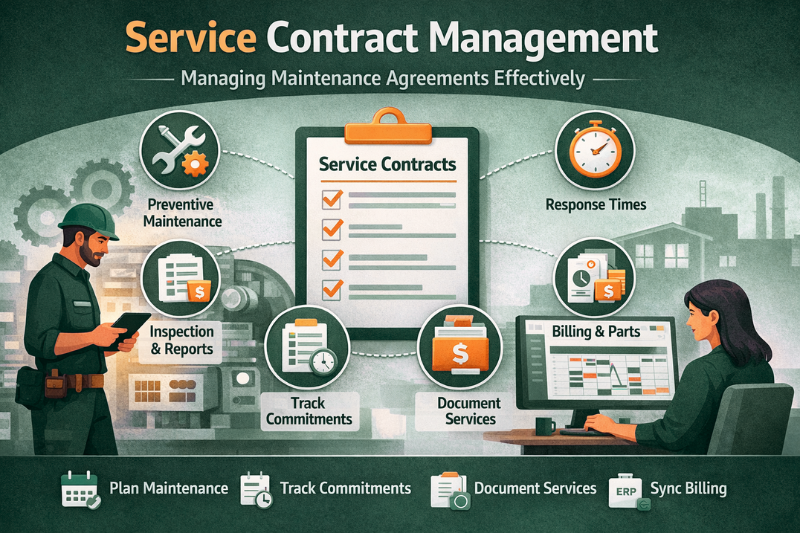
Service contract management overview

Service contract management overview

Connecting contracts with the installation base

Service contracts are closely linked to the equipment installed at customer sites. 

Each contract typically applies to a defined set of machines. These machines form the installation base that the service provider is responsible for maintaining. 

Effective contract management therefore requires a clear connection between the contract and the equipment records. 

Service platforms such as Wello connect contracts directly with the assets covered by the agreement. 

This means that maintenance schedules, service conditions, and inspection requirements can be associated with each machine. 

When preventive maintenance plans are defined within the contract, the system can automatically generate work orders according to the agreed schedule. 

This ensures that contractual obligations translate directly into operational activities. 

Technicians performing maintenance visits can then document their work within the equipment record, creating a clear link between the contract and the completed service. 

Structuring maintenance obligations

One of the main purposes of service contracts is defining maintenance obligations.

These obligations often include periodic inspections and preventive maintenance visits designed to maintain equipment reliability.

For example, a contract may specify that equipment must be inspected twice per year. Another contract may require quarterly maintenance visits.

Service contract management systems help organizations structure these requirements.

Maintenance plans can be defined according to the contract terms. The system can then generate preventive maintenance work orders automatically.

Planners receive visibility into upcoming maintenance obligations and can schedule technicians accordingly.

This structured approach reduces the risk of missed maintenance visits and ensures that contractual commitments remain visible within operational workflows.

Managing service response commitments

Service contracts often include response time commitments.

Customers operating critical equipment may require rapid response when failures occur. Contracts may define maximum response times for service requests depending on the severity of the issue.

For example, critical incidents may require technician response within a few hours, while less urgent issues may allow longer response windows.

Service contract management systems help organizations monitor these commitments.

When a service request is registered, the system can identify the contract associated with the equipment and apply the relevant service conditions.

Planning teams can then prioritize interventions according to these contractual obligations.

This ensures that high priority incidents receive the attention required while maintaining visibility over other scheduled service activities.

Aligning contracts with operational planning

Managing service contracts effectively requires close coordination with operational planning.

Preventive maintenance visits must be scheduled according to contract conditions. Response commitments must be respected when incidents occur.

Operational planning systems therefore play a key role in executing service contracts.

Service platforms allow planners to view upcoming maintenance obligations directly within their scheduling environment.

This visibility allows planners to integrate contract related work orders into technician schedules efficiently.

Maintenance visits can be grouped geographically, reducing travel time while ensuring that contractual obligations remain fulfilled.

This integration ensures that service contracts are not managed as isolated administrative documents but as operational programs executed through daily service activities.

Documenting service delivery

Service contracts often require detailed documentation.

Customers may request service reports confirming that maintenance visits were completed. Inspection procedures may require specific measurements or verification steps.

Service platforms provide structured tools for capturing this documentation.

Technicians can complete inspection forms, record measurements, attach photos, and collect digital signatures during each intervention.

These records remain linked to both the equipment and the service contract.

When customers request documentation or when regulatory authorities require inspection records, organizations can retrieve the relevant reports directly from the system.

This transparency improves trust between service providers and customers while simplifying compliance management.

Supporting billing and financial processes

Service contracts also define commercial conditions.

Some contracts include fixed price maintenance agreements. Others may combine scheduled maintenance with additional billing for parts or labor.

Accurate billing therefore depends on connecting service activities with contract terms.

Service platforms can synchronize operational data with financial systems such as ERP software.

Work orders completed under service contracts can provide the data required for billing processes.

Parts usage, labor time, and contract conditions remain aligned with financial records.

This integration reduces manual reconciliation and improves accuracy in billing operations.

Managing contract portfolios at scale

As service organizations grow, the number of active service contracts increases significantly.

Companies may manage hundreds or thousands of agreements across multiple regions and customer segments.

Without structured systems, maintaining oversight of these contracts becomes difficult.

Service platforms provide centralized visibility over the contract portfolio.

Managers can review contract coverage across the installation base. Upcoming maintenance obligations remain visible. Service performance can be evaluated according to contractual commitments.

This visibility helps organizations maintain operational control while continuing to expand their service activities.

Supporting long term customer relationships

Service contracts often represent long term partnerships between service providers and customers.

Customers depend on service providers to maintain their equipment reliably over many years.

By managing contracts through structured operational systems, service organizations can deliver consistent service quality.

Preventive maintenance visits occur on schedule. Response commitments are respected. Documentation remains accessible.

Customers gain confidence that their equipment is maintained according to defined standards.

Service providers benefit from predictable service workloads and opportunities to expand service offerings.

This reliability strengthens customer relationships.

Service contracts as the operational framework for service organizations

Service contracts transform service delivery from reactive support into structured long term maintenance programs.

By defining maintenance obligations, response commitments, and documentation requirements, contracts establish the framework within which service organizations operate.

However, these agreements only deliver value when they are integrated with operational systems.

Platforms such as Wello help organizations connect service contracts with equipment records, preventive maintenance schedules, planning workflows, and service documentation.

This structured approach ensures that contractual commitments remain visible within daily operations.

Technicians perform maintenance according to defined procedures. Planners coordinate service activities based on contractual obligations. Managers gain visibility into service performance.

As installation bases grow and contract portfolios expand, structured service contract management becomes essential for maintaining operational clarity and delivering consistent service quality.

Pankaj Kumar Thakur

Pankaj Kumar Thakur

Pankaj is a Product Marketing expert with 10+ years in SaaS and IoT, blends engineering, product management, and marketing expertise. At Wello, he drives the evolution of field service software, ensuring seamless operational integration. His experience in customer experience and data management has empowered global enterprises to boost productivity, efficiency, and customer acquisition.

Ready to take the next step?

Save time and minimize risk with the all-in-one tool offering a robust opеrations management solution
tailorеd for companies spеcializing in installation, maintеnancе, and rеpair sеrvicеs.


Get Started