Why Margin Protection Requires More Than Scheduling And What Equipment-Centric Service Companies Should Do Instead?
Field service companies rarely lose money because technicians cannot fix equipment.
They lose money because information is scattered.
A job is completed, but travel time was not billed correctly.
A service contract had special pricing, but no one noticed.
A machine keeps breaking down, but no one sees the pattern.
A report is written on paper and retyped later with mistakes.
Over time, small leaks turn into serious margin problems.
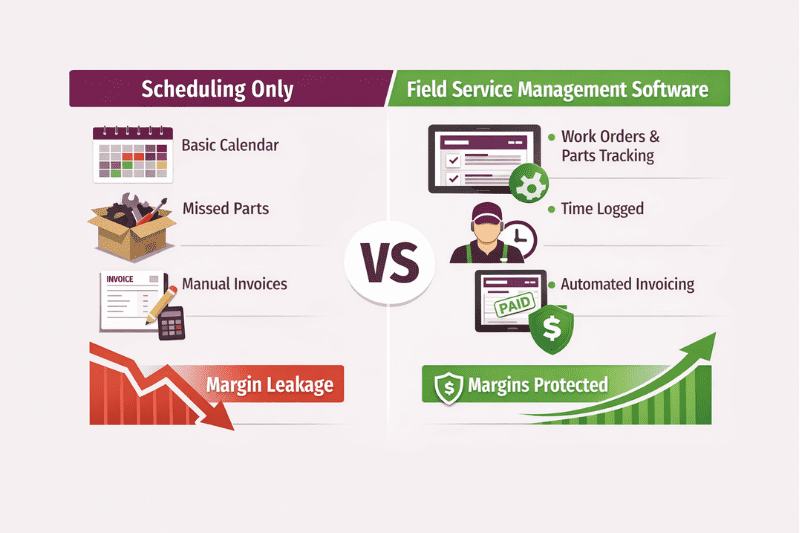
This is where many field service management software tools fall short. They help schedule jobs. They digitise work orders. But they do not truly connect your service operation.
And when your operation is not connected, you are guessing more than you realise.
Scheduling vs field service management software
The Real Problem Is Not Scheduling
Most field service software focuses on dispatching.
That sounds logical. Technicians need to be assigned. Calendars need to be filled. Work orders need to be tracked.
But scheduling is only one part of running a service business.
The real challenge in service operations is control.
Do you know which equipment costs you the most to maintain?
Do you know which service contracts are no longer profitable?
Do you know if all travel time and parts are being billed correctly?
Do you know how often the same machine fails?
If you cannot answer these questions quickly, your field service management system is not giving you control.
It is only helping you manage tasks.
Why Equipment History Changes Everything
In many companies, work orders are treated as separate events. A job is created, completed, invoiced, and closed.
Then the next job starts from scratch.
But equipment maintenance does not work like that in real life.
Equipment has a history. It has been installed, repaired, inspected, and maintained over years. Service contracts define what is included and what is not. Pricing rules vary between customers.
When your field service management software connects each work order directly to the exact piece of equipment, something changes.
You begin to see patterns.
You notice that one type of machine fails every six months.
You see that certain contracts require more visits than expected.
You realise that some equipment is costing more than it should.
Instead of reacting to breakdowns, you start managing long-term equipment performance.
That shift alone can protect margins.
The Hidden Cost of Disconnected Systems
Many service businesses use different tools for different tasks.
Work orders in one system.
Equipment history in another.
Service contracts in spreadsheets.
Invoices in accounting software.
Every time information moves between systems, there is risk.
Someone forgets to apply special pricing.
A technician forgets to register a part.
A report is incomplete.
An invoice is delayed because details are missing.
The office spends time checking and rechecking information that should already be correct.
This does not just slow you down. It costs money.
When customers are not billed accurately or on time, cash flow suffers. When service contract conditions are not applied correctly, margins shrink.
A connected field service management system removes that friction.
When a technician closes a work order, the equipment record updates.
When parts are used, stock adjusts.
When contract pricing applies, it is calculated automatically.
Information flows once and stays consistent everywhere.
What Control Looks Like in Practice
Imagine this instead.
A dispatcher opens the planning screen and sees not just who is available, but who is certified for that specific equipment.
The work order already shows the service contract terms and pricing conditions.
The technician arrives on site with full equipment history, previous repairs, manuals, and safety notes already visible in the mobile field service app.
Even without internet, the technician completes the job, fills in a digital checklist, adds photos, and records parts used.
Once finished, the field service software already knows how the job should be billed.
The office does not rebuild the invoice from scratch. They review and send it.
The equipment history is updated automatically.
No double entry. No confusion. No missing information.
That is what control in service operations looks like.
Protecting Margins Is About Small Details
Service businesses rarely lose money in one big mistake.
They lose money in small, repeated gaps.
Travel time not recorded.
Parts not logged properly.
Discounts applied without tracking.
Preventive maintenance visits taking longer than planned.
When pricing rules are built into the work order from the start, these gaps close.
Hourly rates, travel charges, service contract conditions, and fixed pricing can all be defined in advance. The field service management software applies them automatically.
Before the invoice goes out, you already know what the job is worth.
This makes it easier to see which contracts are healthy and which need attention.
Better Field Work Leads to Better Results
Technicians should not waste time searching for information.
When they arrive on site with full equipment maintenance history and clear instructions, they are more likely to fix the issue on the first visit.
Digital reports reduce paperwork. Photos and signatures are captured immediately. Parts are recorded as they are used inside the mobile field service system.
The result is simple.
Fewer repeat visits.
Fewer misunderstandings.
Faster billing.
Stronger customer trust.
Customers Notice When You Are Organised
Customers may not see your field service management software, but they feel the difference.
When they receive clear updates.
When service reports arrive instantly.
When invoices match the agreed service contract.
When technicians show up prepared.
Trust grows.
And long-term service relationships depend on trust.
Service Businesses That Take Control Operate Differently
There is nothing wrong with simple field service software if your operation is simple.
But if you manage equipment long term, operate under service contracts, run field and workshop teams, and care about protecting margins, you need more than a digital calendar.
You need a field service management system that connects:
- Equipment history
- Work orders
- Service contracts
- Pricing
- Technicians
- Stock
- Invoices
When everything is linked, you stop reacting and start managing.
You see where money is made.
You see where money is lost.
You see where improvement is possible.
And that changes how you run your service business.
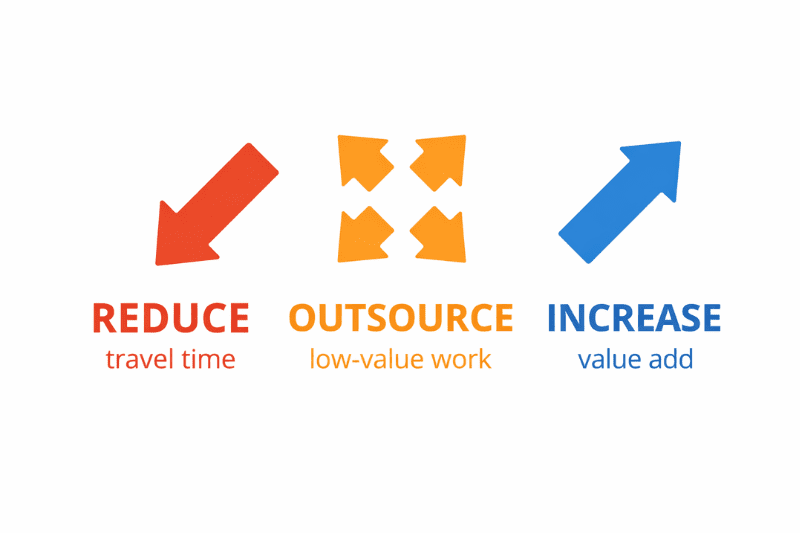
Key strategies for business growth
The Outcome: Fewer Surprises, Better Control, Stronger Margins
When your field service operation is connected from equipment to invoice, three things happen.
You reduce mistakes.
You protect profitability.
You operate with confidence.
Not because the software looks modern.
But because your field service management system finally gives you clarity.
And clarity protects margins.