
A practical guide to Europe-first field service management software, comparing leading providers and explaining how European service businesses handle compliance, language, and cross-border operations.

Field service operations in the European space are very far from being regular global market operations. They’re a daily reality of different aspects that matter commercially, legally, and operationally.
For instance, a service business can cross a border in two hours and enter a new language, VAT structure, documentation standard, and customer expectation. Technicians work in multilingual regions. Finance teams need accurate cross-border invoicing.
All of this is why the “Europe-first field service management software” discourse is more than just a geographical narrative; it’s a design philosophy. It’s about a software built around European realities from day one.
From multi-language workflows that are beyond simple translation, to GDPR-compliance, to EU-grade data sovereignty and cross-border processes that scale smoothly across currencies and countries.
In this guide, you’ll get a decision-focused analysis of leading European FSM providers so you can identify the right long-term partner for your growth, compliance, and operational model. If you’re evaluating field service software for European businesses, this is for you.
| Provider | Best For | Company Size Fit | Cross-Border EU Ready | GDPR & Data Sovereignty | Deployment Speed | Standout Strength |
| Wello | Agile and asset-centric European service businesses scaling across countries | Small, medium, and large enterprises. Wello offers tailored plans that are suitable for companies of different sizes | Native multi-language, multi-currency, and multi-country architecture | EU-hosted, GDPR-by-design, ISO-aligned | Fast(It’s a matter of weeks) | All-round platform + compliance without unnecessary complexity |
| IFS | Asset-heavy enterprise service operations | Mid-market to large enterprise companies | Enterprise-grade multi-country capability | Advanced compliance controls | Moderate | Asset lifecycle management |
| Comarch | Telecom & utilities | Medium to large-sized enterprises | Multi-market implementation experience | EU regulatory alignment | Moderate | Industry specialization |
| Praxedo | Field-team focused SMBs | Small and Medium-sized Businesses (SMBs) and large enterprises | Multi-language European deployments | EU-hosted infrastructure | Fast | AI scheduling & mobility |
| OverIT | Utilities & infrastructure operators | Large enterprise businesses | Designed for distributed EU infrastructure network | Compliance-ready enterprise hosting | Moderate | Geospatial intelligence |
| Solvares Group | Manufacturing service divisions | Medium to large companies | Regional multi-country support | EU-based data governance | Moderate | Planning & optimization |
| Service 1 | Salesforce-centric organizations | Mid-market to large enterprises | Cross-border capability, but dependent on Salesforce configuration | Compliance framework via Salesforce | Moderate | Salesforce-native FSM |
| iTSM Group | ServiceNow enterprise users | Small to medium-sized enterprises | Multi-country capability via ServiceNow architecture | Enterprise compliance via ServiceNow | Moderate | ServiceNow expertisWhat “Europe-First” Really Means in FSM? |
When a Dutch HVAC company expands into Belgium, it doesn’t just require a new language toggle. It needs Dutch and French documentation, VAT logic that adapts across borders, technician contracts aligned with regional labor laws, and reporting that satisfies GDPR scrutiny.That is the difference between translated software and Europe-first field service management software.
Many global FSM platforms claim European presence. They may offer servers in Frankfurt or Paris and translate their interface into German or French, but that does not automatically make them European-first.
A genuinely European FSM platform is designed around:
The distinction is architectural. Europe-first systems are built around European friction points from day one.
In Europe, regulation shapes technology.
The General Data Protection Regulation (GDPR) directly impacts field service management. Technician GPS tracking, digital work orders, customer signatures, and asset histories all contain personal data. Lawful basis, auditability, and encryption are mandatory.
Then there is sustainability. The EU Green Deal and Corporate Sustainability Reporting Directive (CSRD) are gradually reshaping operational reporting.
For instance, route optimization is no longer just about fuel savings. Companies now have to be accountable for their emissions. This means Modern FSM needs to support efficient routing and generate CSRD-aligned sustainability reports.
Country-level requirements add another layer to these complexities. For instance, Germany has distinct labor structures, France operates with specific social security frameworks, and amidst all of these, several e-invoicing mandates are consistently being rolled out across the EU.
Due to these complexities, a Europe-first FSM platform must anticipate this complexity rather than retrofit around it.
Europe is not one homogeneous business culture.
DACH organizations often favor precision, documentation depth, and structured implementations. Nordic companies typically expect streamlined digital experiences and intuitive interfaces. Southern European markets tend to prioritize relationship continuity and operational flexibility.
With enough information, you’ll quickly come to realize that an FSM offering Multi-language support in Europe is simply the baseline. Understanding and adapting to the operational nuances is what separates a true European partner from a translated global product.
One of Europe’s strengths is its openness, but this same openness introduces complexity.
For instance, a Belgian service company operating in Flanders and Wallonia needs to manage Dutch and French-speaking technicians.
If this company decides to expand into Luxembourg or Northern France, it will have to adapt to the shift in invoicing rules, VAT rates, and required documentation.
This is one of the reasons why cross-border field service management in the EU demands a platform with native multi-currency support. In addition to that, companies also require intelligent taxation handling and the ability to generate localized documents on the fly.
Platforms built for a single market often struggle or fail when confronted with these subtleties.
For European businesses, data sovereignty is no longer an abstract concept. The critical questions are:
European-first providers host in EU-based data centers and structure their entire compliance framework around European regulatory frameworks. This alignment builds essential digital trust, especially in regulated sectors like utilities, telecom, healthcare, and critical infrastructure.
Software inevitably encounters friction during deployment and scaling. When it does, support must understand European accounting structures, labor rules, and operational workflows.
A Europe-first partner provides assistance during European business hours, in relevant languages, and with awareness of the local regulatory environment. That contextual understanding reduces risk during implementation.
European field service management software solutions reflect the continent’s regional strengths.
Nordic software traditions emphasize digital maturity and design simplicity. DACH-based systems often focus on engineering robustness and structured methodology.
Southern European providers frequently balance flexibility with strong customer engagement. Meanwhile, central European vendors have built reputations around scalability and cost-effective customization.
This diversity means European businesses can choose an FSM philosophy aligned with their operational culture.
The critical question is not “Which provider is the biggest?” but “Which provider understands how my business operates within Europe?”
Below is a comparative review of leading European field service solutions. This section pays attention to regulatory depth, architectural philosophy, and practical fit.
Wello Solutions represents a new generation of Europe-first field service management software. Headquartered in Brussels with additional presence in France, Wello was built cloud-native from the onset.
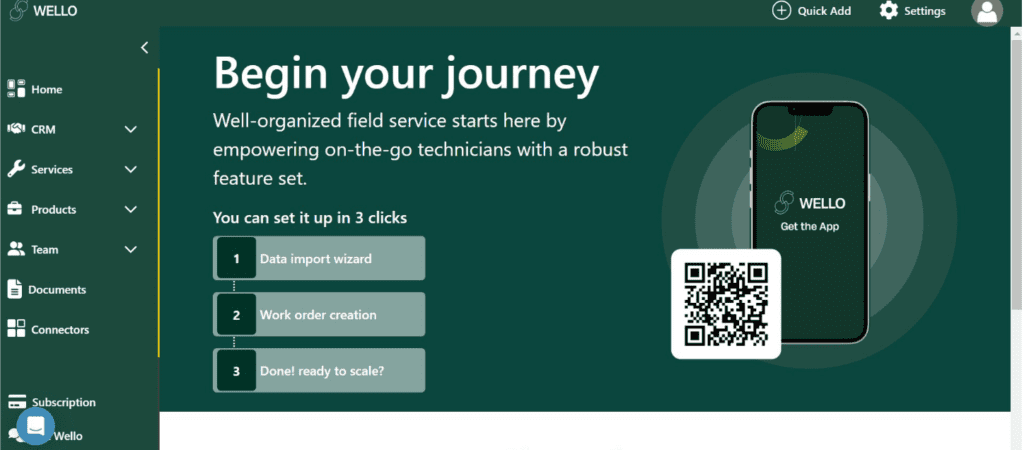
It’s a dedicated solution that was designed for today’s European service environment. Rather than evolving from legacy enterprise systems, Wello’s architecture is mobile-first, API-driven, multilingual, and GDPR-aware by design.
In addition, Wello’s data hosting is also aligned with EU data sovereignty standards. The platform’s data is hosted in secure ISO/IEC 27001-certified European data centers.
Its multi-currency support (EUR, GBP, CHF, and more) and genuine multi-language workflows also make it particularly suitable for companies operating across multiple European markets.
What makes Wello’s European positioning credible is how it performs in real deployments across industries and borders.
At SAUTER Controls, a major building automation group operating across Switzerland and Germany, Wello unified a complex multi-party service ecosystem involving building owners, tenants, and maintenance providers.
In the Netherlands, ROMASS integrated Wello with Exact Online to automate the full service lifecycle. Technicians complete work orders in the mobile app, customers sign digitally, and invoices are generated automatically through Exact. The company was fully operational within two weeks.
In Belgium, Dimix moved from paper-based planning to fully digital field service management with ERP integration into Exact Online. The results were improved first-time-fix rates, real-time stock visibility, automated invoicing, and reduced manual rework.
Together, these cases reflect Wello’s reach across Europe and its adaptability across several industries. It delivers enterprise-grade functionality such as advanced scheduling, route optimization, reporting, and integrations without enterprise complexity.
IFS is a long-established European enterprise software provider with global reach. Its FSM and asset management capabilities are especially strong in utilities, aerospace, and heavy manufacturing.
IFS excels in asset lifecycle management and complex contractual service environments. Its solutions are typically deployed within large enterprises where long implementation timelines and high configurability are acceptable.
For large, asset-intensive European organizations, IFS remains a serious contender. However, its complexity and cost structure may exceed the needs of smaller or mid-market service businesses.
Comarch has built strong credibility in telecom and utilities across Europe. Its FSM capabilities are often integrated into broader industry platforms.
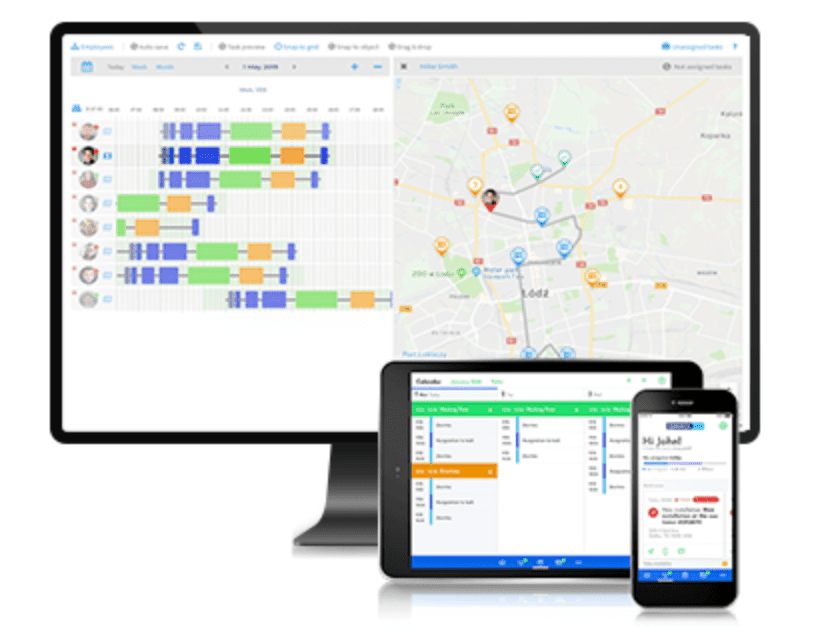
Praxedo focuses on mobile workforce management and intelligent scheduling. It has built a strong European presence with a cloud-first orientation.
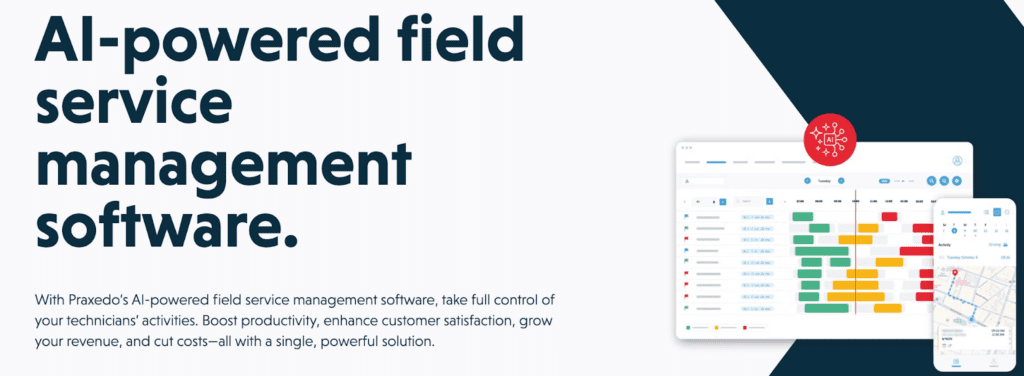
Its AI-based dispatching and technician mobility tools make it attractive for companies prioritizing field efficiency. Pricing models often align well with SMB and mid-market businesses.
However, Praxedo is particularly effective for organizations that are field-team centric rather than asset-heavy.
OverIT is a Field Service Management provider with a particularly strong footprint in utilities, energy, and telecommunications. Its positioning reflects a clear Europe-first orientation, with strict adherence to GDPR requirements and options for EU-restricted data residency.
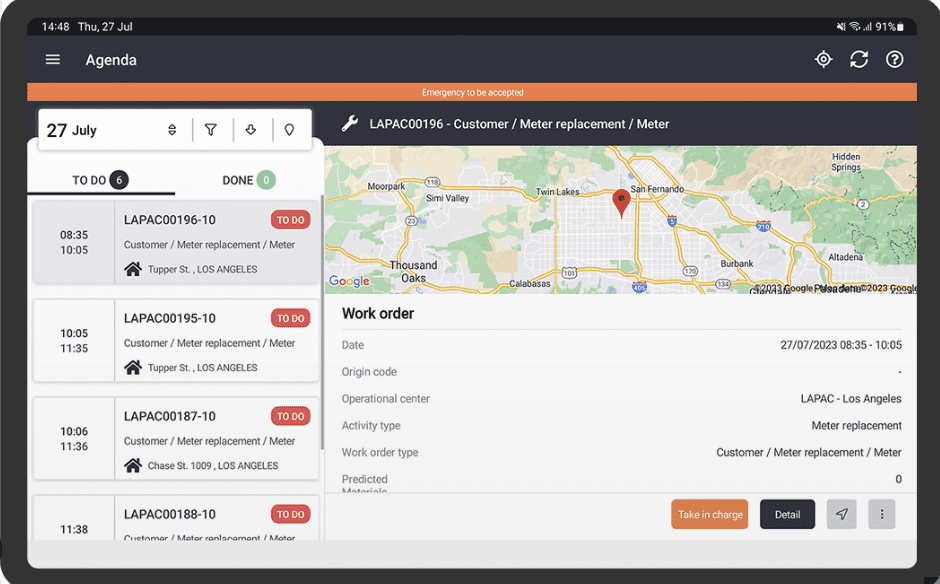
The platform’s core differentiation lies in its GIS integration and linear asset specialization. For utilities managing electricity grids, water networks, or telecom infrastructure across large territories, OverIT is able to provide support with its native geospatial capabilities.
Its API-first architecture supports integration with enterprise ecosystems such as SAP and a few others. These capabilities make the platform strong in high-volume, compliance-heavy operations.
However, OverIT’s depth comes with complexity. Implementations typically require structured onboarding and training to unlock full functionality.
As such, it is best suited to large enterprises managing complex networked assets rather than smaller service organizations seeking rapid, lightweight deployment.
The Solvares Group is an FSM and logistics specialist that was formed through the merger of established optimization-focused providers. Solvares has built a reputation around operational efficiency in manufacturing, engineering, and industrial service environments.
Its differentiation lies in AI-driven scheduling, particularly through its POWEROPT algorithm, which enables real-time dispatching. According to the platform, this approach reduces planning effort while improving technician utilization and lowering CO₂ emissions.
Solvares is particularly attractive to mid-market industrial service divisions that prioritize measurable efficiency gains. However, its focus on optimization depth may feel operationally heavy for smaller service businesses seeking broader workflow simplicity rather than advanced scheduling sophistication.
Service 1 positions itself as a specialized provider of field service solutions built within the Salesforce ecosystem.
Its value proposition is strongest for organizations that already rely heavily on Salesforce CRM and want to extend service operations directly into that environment without introducing a separate platform.
By operating natively within Salesforce architecture, Service 1 enables unified reporting, centralized customer data, and integration with sales and service workflows. This makes it appealing for mid-market and enterprise organizations that want a single-platform strategy.
In compliance-sensitive European environments, Service 1 uses the Salesforce framework to align with GDPR and establish enterprise security standards.
The trade-off is architectural dependency. Businesses are tied to Salesforce licensing, configuration, and ecosystem constraints.
For companies not already standardized on Salesforce, this can introduce cost and structural complexity that may outweigh the integration benefits.
iTSM Group operates primarily as a ServiceNow-focused implementation and consulting partner. They deliver Field Service Management capabilities within broader IT Service Management (ITSM) and digital transformation programs.
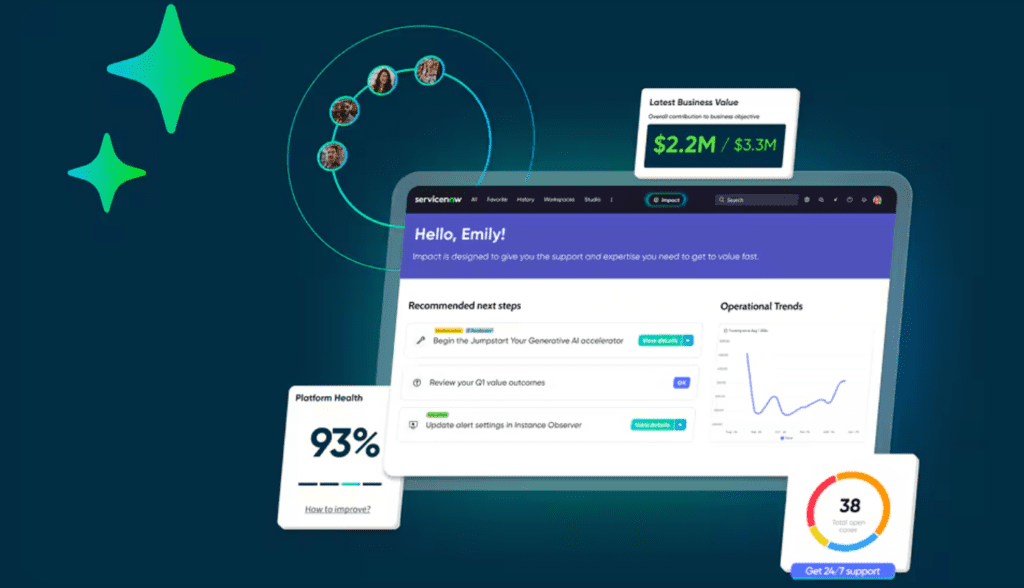
This platform operates in a consulting-led manner by guiding organizations from design through technical deployment and ongoing application management.
Due to the fact that they specialize in ServiceNow environments, iTSM Group is particularly relevant for large European enterprises that prioritize governance, compliance, and structured service workflows.
Also, their model is transformation-oriented rather than product-centric. This means that engagements are typically larger in scope and duration.
As a result, this makes iTSM Group most appropriate for enterprise-scale initiatives rather than smaller service companies seeking standalone FSM software with rapid time-to-value.

Selecting the right European field service solution depends on company size, industry complexity, and geographic scope.
Flexible businesses of varying sizes often benefit from agile, cloud-native systems such as Wello that combine compliance and usability. Overall, the key is alignment between operational complexity and architectural philosophy.
It is software architected around European regulatory, linguistic, and operational realities rather than adapted from non-European systems.
GDPR governs how technician location data, customer information, and service records are processed. It requires a lawful basis, encryption, and clear data processing agreements.
For regulated industries, EU data residency reduces compliance risk and simplifies contractual frameworks.
Yes, if it supports multi-language workflows, multi-currency billing, and flexible VAT configuration at the system level.
Through route optimization, carbon tracking modules, and alignment with EU reporting directives.

Not a Wello Solutions user yet? Schedule your demo today to see how we can streamline your field service operations.

In an era where customer expectations are soaring, field service management has become a critical aspect for businesses. It’s a key differentiator that can make or break customer satisfaction
Learn more →
Future integration trends in 2026 focus on APIs, real-time data, automation, and security, helping businesses build connected, intelligent digital ecosystems.
Learn more →
Learn what building maintenance means, its main types, and how Wello Solutions helps companies manage repairs, inspections, and upkeep with clarity and control.
Learn more →Save time and minimize risk with the all-in-one tool offering a robust opеrations management solution
tailorеd for companies spеcializing in installation, maintеnancе, and rеpair sеrvicеs.






 Wello App.