
ESG reporting for field service and asset-based businesses explained simply—covering environmental, social, and governance practices driven by real operational data.

Environmental, social, and governance reporting, often shortened to ESG reporting, has become part of everyday business discussions across industries. What started as a topic mainly discussed by large corporations and financial institutions is now reaching service companies, technical operators, and asset-based organizations. Businesses that install, inspect, maintain, or repair equipment are increasingly expected to understand and document how they operate, how they treat people, and how they manage risk.
For companies working in the field, ESG reporting is not about polished reports or marketing claims. It is about making daily operations visible, measurable, and understandable. It connects sustainability goals with real work orders, real technicians, real equipment, and real decisions made on the ground.
This article explains what ESG reporting really means, why it matters for field service and asset-focused companies, how it differs from older sustainability ideas, and how digital tools like field service management platforms support practical ESG reporting without adding unnecessary complexity.
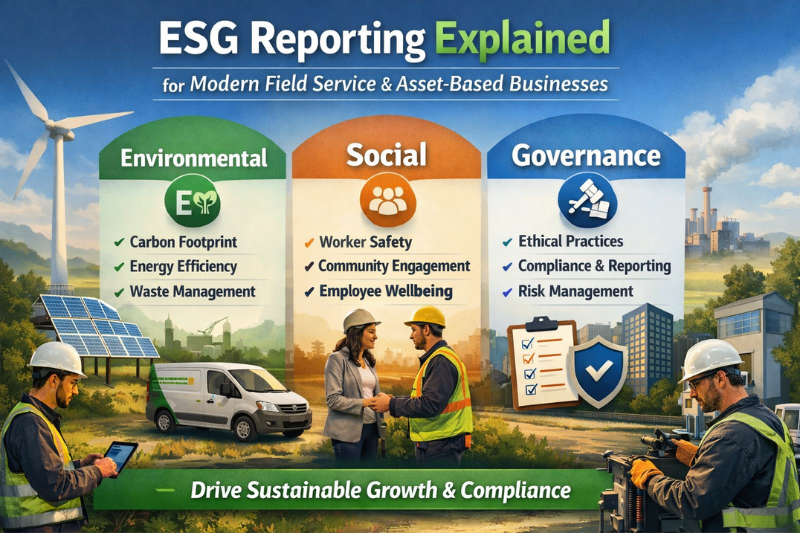
ESG reporting is the structured disclosure of how a company performs in three areas: environmental impact, social responsibility, and governance practices. Instead of focusing only on revenue and costs, ESG reporting looks at how a business operates in the real world.
For a service organization, this includes how vehicles are used, how energy is consumed, how technicians work safely, how customers are treated, and how decisions are documented and controlled. ESG reporting turns these daily activities into data that can be tracked, explained, and improved over time.
It is not about perfection. It is about clarity and consistency. Businesses use ESG reporting to show where they stand today, what they are improving, and how they manage risks and responsibilities linked to their operations.
ESG reporting has moved from being optional to being expected. Investors, customers, regulators, and even employees want to understand how companies operate beyond financial performance.
For field service businesses, this shift is especially relevant. These companies operate vehicles, manage equipment, work at customer sites, and rely heavily on people in the field. This creates a direct environmental footprint and a visible social impact.
ESG reporting helps these businesses explain their role clearly. It shows how travel is reduced through better planning, how maintenance prevents waste, how safety is managed, and how compliance is handled across many jobs and locations. It also supports better internal decisions by making operational data easier to understand and use.
The terms ESG, sustainability, and corporate responsibility are often mixed together, but they are not the same.
Sustainability usually focuses on environmental topics such as energy use, emissions, and resource consumption. Corporate responsibility often focuses on people, ethics, and community involvement.
ESG reporting brings these ideas together into one structured system. It connects environmental and social actions to governance, measurement, and accountability. Instead of separate initiatives, ESG reporting creates a common framework that links operations, reporting, and long-term planning.
For field service companies, this structure is important. It allows sustainability efforts to be connected directly to work orders, assets, technicians, and customers instead of remaining abstract goals.
Environmental reporting focuses on how a company uses resources and affects the environment. For service businesses, this often includes vehicle usage, fuel consumption, energy use, waste from repairs, and equipment lifecycle management.
Tracking environmental impact does not require complex systems. When jobs, routes, spare parts, and assets are managed digitally, much of the required data already exists. ESG reporting simply organizes this information to show trends and improvements.
Preventive maintenance, fewer repeat visits, better planning, and accurate asset records all contribute directly to environmental performance. ESG reporting helps make these connections visible.
The social side of ESG reporting focuses on people. This includes employee safety, working conditions, training, diversity, customer protection, and responsible supplier relationships.
In field service, social responsibility shows up in practical ways. Are technicians working safely? Are instructions clear? Are working hours reasonable? Are incidents recorded and addressed? Are customers treated fairly and transparently?
Digital work orders, safety checklists, job documentation, and customer records all support social reporting when used consistently. ESG reporting brings these elements together to show how people are supported across the organization.
Governance is about how decisions are made, recorded, and controlled. This includes internal rules, approvals, data accuracy, compliance processes, and accountability.
For asset-based service businesses, governance often depends on how well information flows between office and field. Clear approvals, traceable changes, documented work, and controlled access to data all support good governance.
ESG reporting uses governance data to show that the business operates in a structured and responsible way. This builds trust with stakeholders and reduces operational and legal risk.
The world of ESG reporting includes both mandatory and voluntary standards. Some companies are required by law to report ESG data, while others choose to do so to improve transparency and competitiveness.
Regulations are becoming stricter, especially in Europe, where sustainability reporting requirements are expanding to include more companies and more detailed data. Even businesses that are not directly regulated often feel indirect pressure from customers or partners who must report themselves.
Voluntary frameworks also play an important role. They provide guidance on what to measure and how to report, helping businesses structure their ESG efforts in a consistent way.
For service organizations, the key challenge is not choosing the perfect framework. It is ensuring that the data behind the reporting is accurate, traceable, and linked to real operations.
An ESG report summarizes how a company performs across environmental, social, and governance areas. It combines numbers with explanations and shows progress over time.
Typical reports include environmental metrics like energy use or travel reduction, social metrics like safety performance or training coverage, and governance information like compliance processes and decision controls.
For field service companies, ESG reports often draw heavily on operational data. This includes job histories, asset records, technician activities, and customer interactions.
Many organizations receive ESG scores from external parties. These scores compare companies within industries and help investors and partners assess risk and responsibility.
While scores can be useful, they depend entirely on the quality of underlying data. Businesses that manage operations digitally are better positioned to provide reliable information and explain their results clearly.
Instead of chasing scores, service companies benefit more from building strong internal reporting foundations that reflect real performance.
ESG reporting delivers value far beyond compliance. It helps companies understand their operations better and improve them over time.
Clear ESG data supports better planning, smarter investment decisions, and more efficient processes. It helps identify waste, reduce unnecessary travel, improve safety, and strengthen customer relationships.
ESG reporting also supports trust. Customers increasingly want to work with service providers who operate responsibly. Employees want to work for companies that care about safety and fairness. ESG reporting provides evidence, not promises.
Many companies struggle with ESG reporting because data is scattered across systems or collected manually. In field service environments, this challenge is even greater due to mobile teams and changing job conditions.
Another challenge is accuracy. Estimates and averages may be easy to produce, but they weaken credibility. ESG reporting works best when it is based on actual operational data.
There is also the risk of overstating sustainability efforts. Transparency matters more than perfection. Honest reporting builds trust, while exaggerated claims damage credibility.
Finally, regulations change. Businesses need flexible systems that can adapt without requiring constant manual rework.
ESG reporting software helps organizations collect, organize, and analyze sustainability data without adding administrative burden. Instead of manual spreadsheets, data flows automatically from operational systems into reporting views.
For field service companies, the strongest ESG reporting setups are those connected to core operational platforms. When work orders, assets, technicians, and customers are already managed digitally, ESG reporting becomes a natural extension of daily work.
Integrated platforms reduce errors, improve consistency, and make ESG reporting part of normal business processes instead of a separate task.
Strong ESG reporting starts with operational data. Businesses should focus on capturing accurate information at the source, such as during job execution, inspections, and maintenance activities.
Consistency matters more than complexity. Clear definitions, standard processes, and regular reviews help ensure reliable reporting.
Stakeholder communication is also essential. ESG reporting should answer real questions from customers, employees, and partners, not just follow templates.
ESG reporting will continue to become more detailed and more connected to daily operations. Digital transparency will increase, and manual reporting will become less acceptable.
For service businesses, this means ESG performance will increasingly reflect how well operations are planned, executed, and documented. Preventive maintenance, efficient scheduling, remote diagnostics, and clear asset records will all play a role.
Technology will support this shift by connecting operational data with sustainability goals in real time.

The first step is understanding what data already exists. Most service organizations already collect much of the information needed for ESG reporting through job management, asset tracking, and technician workflows.
The next step is connecting this data into a clear structure that supports reporting and decision making. This is where integrated field service platforms provide strong value.
Choosing tools that grow with regulations and business needs helps avoid rework later. Flexibility, automation, and audit readiness should guide any ESG reporting investment.
ESG reporting is no longer just about external expectations. It is becoming a way to improve how service businesses operate every day.
When sustainability, people, and governance are embedded into work orders, asset management, and planning, ESG reporting stops being a burden. It becomes a reflection of good operational discipline.
For field service and asset-based companies, ESG reporting is not a separate initiative. It is the result of running operations clearly, responsibly, and digitally, exactly where the work happens.

Not a Wello Solutions user yet? Schedule your demo today to see how we can streamline your field service operations.

This guide explores the role of FSM software in the electrical industry and provides best practices to help businesses improve service delivery and drive growth.
Learn more →
Manage work orders inside buildings or out in the field with Wello. Keep teams connected, tasks organized, and jobs done right — anytime, anywhere.
Learn more →
Ralco Technic uses Wello to manage cross-border cooling projects with ease, improving coordination, reducing delays, and keeping every job clear and on track.
Learn more →Save time and minimize risk with the all-in-one tool offering a robust opеrations management solution
tailorеd for companies spеcializing in installation, maintеnancе, and rеpair sеrvicеs.







 Wello App.