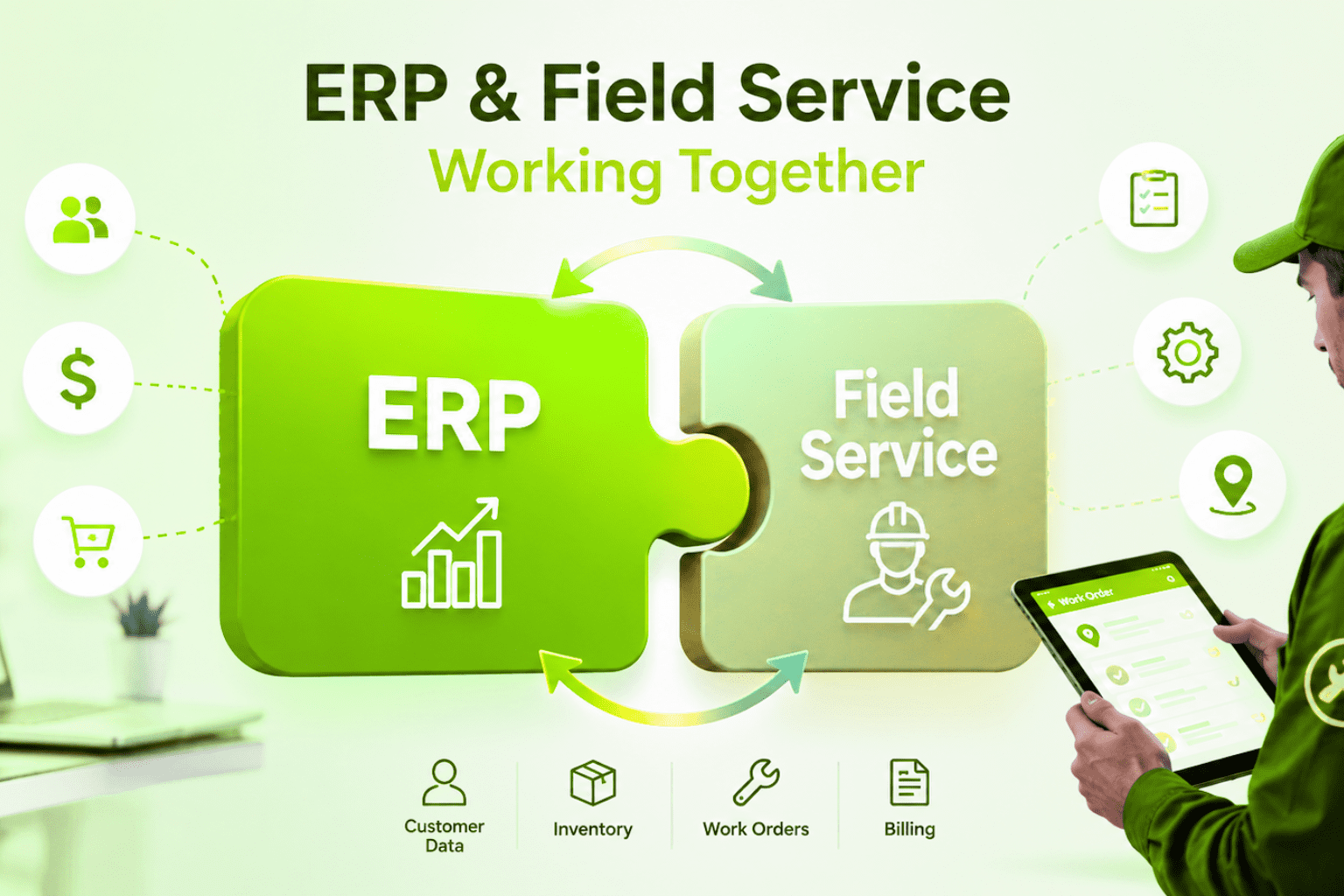

Some service markets are more revealing than others. In compliance-heavy, cross-border operating environments, Field Service Management (FSM) systems get stress-tested quickly because there’s less tolerance for fragmented data and manual reporting.
Organisations have begun to move beyond basic digitisation and the gap between companies that simply digitalise field operations and those that truly transform them is becoming increasingly visible.
Since regulatory obligations are stricter, customer expectations are consistently high, and teams operate across languages and jurisdictions, selecting an FSM platform is no longer a tactical IT decision. It has become a strategic choice that directly impacts compliance and productivity.
That’s why this guide is intentionally market-first. Rather than starting with vendors and feature lists, it begins with the operating conditions that shape modern field service maturity. It then evaluates three FSM platforms that repeatedly show up in European buying cycles.
Quick Look: Best FSM Software (2026 Snapshot)
This table summarises how the three options stack up against the typical requirements of companies running European ERP/accounting stacks and preparing for e-invoicing mandates.
| Benelux Decision Factor (2026) | Wello | FieldBuddy | Relyon One | Fast Take |
| Best for cross-border Benelux operations | Strong (built for NL/BE/LU realities) | Moderate | Limited | Wello |
| Language fit (Dutch/French/English) | Multilingual supports | Moderate (NL-first) | NL-first | Wello |
| Compliance readiness (GDPR + audit evidence) | High (compliance-by-design) | High (Salesforce ecosystem) | Moderate | The decision here will be majorly determined by the compliance needs specific to your business. But for most cases, Wello covers your needs. |
| PEPPOL e-invoicing readiness (2026) | PEPPOL-ready | Not a specified offering. Could vary by setup | N/A | Wello |
| Local ERP/accounting integration | A wide range offering including Exact Online, AFAS Software, Microsoft Dynamics 365 Business Central / NAV, Visma eAccounting, VEKA Connector, SAP Business One, and many more | Offers Exact Online & Exact Globe, AFAS, Visma AccountView, Unit4, Twinfield, DBFact, SAP Business One, and Microsoft Dynamics | Offers Exact (Online/Globe), AFAS Profit, SAP, MS Dynamics (Microsoft Dynamics), Unit4, Infor, Acto, MKG, Gildebouw, and King | The decision depends on the integration stack your business uses. However, Wello has a broad range of options that can cover most integration needs. |
| Implementation speed | 2-4 weeks | 4-8 weeks | 4-6 weeks | Wello |
| Offline mobile performance | Excellent | Very good | Very functional | All platforms excel in this aspect |
| Best fit by company type | Growth-focused SMEs and large enterprises | NL-led SMEs with complex processes | Smaller NL service teams | The decision depends on the context of your business, but Wello offers tailored solutions to match businesses across several tiers |
The State of FSM in 2026
Field service management has moved past the early digitisation phase.
Most medium-sized service organisations already use some form of mobile work orders or planning software. Yet many still struggle with fragmented data, heavy compliance overhead, and systems that were never designed for cross-border European operations.
Between 2024 and 2026, three forces are reshaping the market:
- Regulatory acceleration, particularly around GDPR enforcement, digital reporting, and mandatory PEPPOL e-invoicing
- Operational pressure driven by technician shortages and rising service costs
- Customer expectations are shaped by real-time transparency and sustainability commitments
As a result, FSM platforms are no longer evaluated solely on features. They’re judged on whether they enable compliance-by-design, deliver localised usability at scale (especially in multilingual environments), and provide future-proof operations through automation, integration, and analytics.
Market Overview: Why Some Service Environments Are Harder Than Others
The European market presents a unique combination of high digital maturity and high operational complexity. The Belgium, Netherlands, and Luxembourg regions for instance, are a perfect example of these regional complexities.
In the Netherlands, FSM adoption is relatively advanced. Dutch organisations prioritise efficiency, automation, and rapid implementation where they often integrate FSM tightly with accounting and ERP platforms such as Exact Online and AFAS.
In Belgium, the landscape is more complex. Field service organisations must navigate bilingual or trilingual workforces, stricter inspection regimes (such as AREI and Scope 12), and more documentation-heavy compliance requirements. FSM software in Belgium must therefore excel at structured reporting and multilingual usability.
Luxembourg, while smaller, often exhibits higher governance and audit expectations due to cross-border employment and international asset ownership. Luxembourg service management places a premium on traceability, role-based access, and data sovereignty.
Across all these environments, asset-heavy industries dominate: utilities, HVAC, energy infrastructure, building management, industrial maintenance, and emerging sectors such as EV charging and solar installations. These sectors require FSM platforms that do more than dispatching technicians. FSM platforms must reliably produce audit evidence, support standardised reporting, and keep the financial back-office in sync without manual reconciliation.
Key Trends Shaping Field Service (2024–2026)
Compliance is becoming operational, not administrative
Compliance has moved from the back office into daily field operations. Regulations such as GDPR, AREI, Scope 12, and sector-specific inspection standards increasingly require structured, auditable data captured at the source. FSM software that relies on manual uploads or post-job reporting is rapidly becoming a liability.
By 2026, leading organisations will treat compliance as an automated output of their FSM workflows, not as a separate process.
Sustainability is now a software requirement
Driven by the EU Green Deal, sustainability is no longer limited to fleet electrification. Customers and regulators expect measurable reductions in emissions, optimised routing, and transparent reporting. FSM platforms that can intelligently reduce travel, optimise scheduling, and support EV planning will gain a decisive advantage.
The technician experience is a strategic lever
The aging technician workforce is a critical issue across regions like Netherlands and Belgium. FSM systems must reduce administrative burden, support offline work, and provide intuitive mobile experiences. Platforms that fail here increase attrition and undermine productivity, no matter how powerful their back-office tools may be.
Digital sovereignty is back on the agenda
CIOs are increasingly scrutinising where data is hosted and under which legal frameworks it falls. EU-based data centres, ISO certifications, and clear GDPR roles are now standard evaluation criteria, particularly in public-sector-adjacent industries.
Essential Requirements for Modern FSM Software
For organisations operating in multilingual, compliance-driven European service contexts, several requirements are increasingly non-negotiable:
- Native support for multilingual interfaces (commonly Dutch, French, and English)
- EU-based data processing with clear GDPR accountability
- PEPPOL-ready e-invoicing ahead of 2026 mandates
- Deep integration with ERP and accounting systems, such as Exact Online and AFAS
- Robust offline functionality for industrial and rural environments
- Asset-centric data models to support inspections, certificates, and lifecycle reporting
FSM platforms that lack these fundamentals will find it increasingly difficult to scale as compliance and customer expectations rise.
Top Field Service Solutions
Wello: The modern, agile FSM platform
Wello stands out as one of the few FSM platforms designed for high-compliance, multilingual service operations, rather than being retrofitted to handle them.
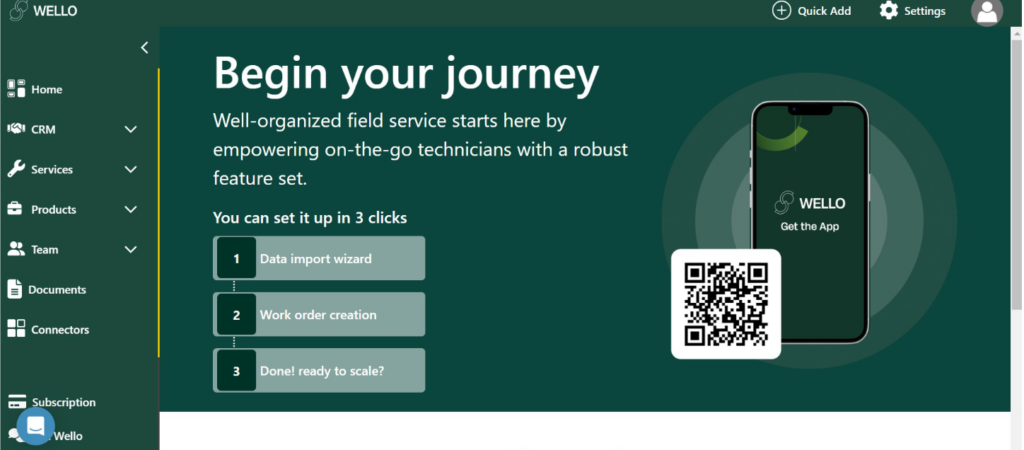
Headquartered in Brussels, Wello has built its platform around European regulatory realities from the ground up. Data is hosted in secure, ISO/IEC 27001-certified European data centres, and GDPR compliance is embedded directly into system architecture through role-based access and audit-ready reporting.
One of Wello’s strongest differentiators is deep localisation without sacrificing scalability. The platform natively supports Dutch, French, and English, which are critical for environments where field teams, customers, and documentation requirements span multiple languages and regions.
In addition, Wello also integrates seamlessly with Exact Online, the dominant ERP and accounting system across many European service organisations. This integration eliminates a major source of administrative overhead by synchronising customers, parts, and invoices automatically.
Operationally, Wello takes an asset-centric approach, which is particularly valuable where inspections, certifications, and lifecycle tracking are central to service delivery. Technicians work with structured checklists and inspection logic tailored to local standards such as AREI and Scope 12.
This helps ensure compliance is produced as a natural outcome of the job.
The mobile application is built for real-world conditions, including industrial zones and rural areas with inconsistent connectivity. Offline work is fully supported, with automatic synchronisation once connectivity is restored.
Real-world implementations underline this positioning. Companies such as Van Parijs Engineering, ista Belgium, Sauter, Equans, and Kiloutou report tangible improvements, including reduced downtime, faster mean time to repair, and significant reductions in manual administration. In multiple cases, MTTR dropped from several days to less than one.
Another decisive advantage is implementation speed. Whereas traditional FSM projects can stretch over months, Wello deployments typically complete within two to four weeks. This makes it particularly attractive for growing SMEs and mid-market organisations expanding across regions.
Taken together, Wello aligns closely with FSM trends for 2026. Wello offers compliance automation, cross-border scalability, sustainability support, and technician-centric design.
FieldBuddy: A good platform for configurable workflows
FieldBuddy has established itself as a credible FSM solution in the Netherlands and Belgium, particularly among service organisations already invested in the Salesforce ecosystem.
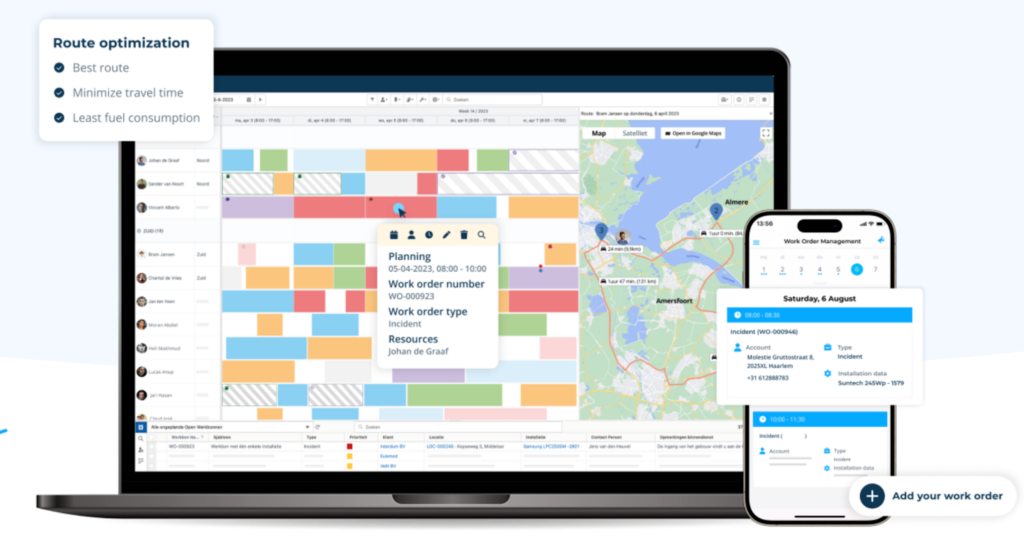
Its strengths lie in flexibility and configurability. FieldBuddy can accommodate complex, non-standard service workflows and integrates well with widely used European accounting systems such as AFAS, Exact, and Visma.
For companies that require tailored processes and are comfortable with Salesforce-based architectures, this can be a compelling proposition.
However, this flexibility comes at a cost. Extensive customisation often increases implementation complexity and total cost of ownership.
Relyon One: Standard Dutch-Centric
Relyon One reflects over two decades of experience in digitising Dutch field service operations. Its appeal lies in standardisation, rapid deployment, and ease of use.
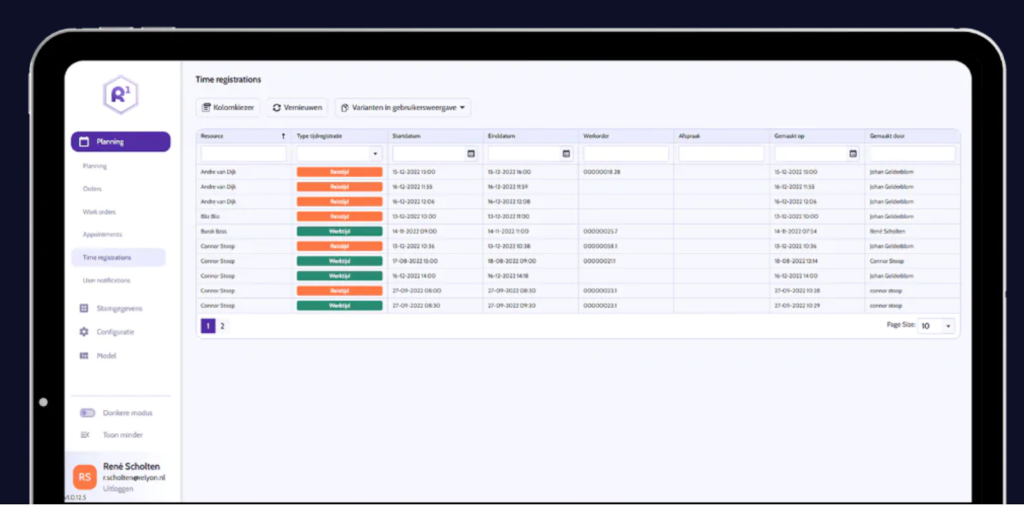
For smaller service organisations seeking a quick transition away from paper-based processes, Relyon One delivers reliable functionality with minimal disruption. Its focus, however, remains largely on the Dutch market, with more limited support for multilingual operations and advanced analytics.
As service models become more data-driven and compliance demands increase, this narrower focus may become a constraint for growing organisations.
Comparative Analysis: FSM Platforms Through a Modern Operations Lens
| Criteria | Wello | FieldBuddy | Relyon One |
| Multilingual support | Full multilingual functionality | Moderate | Limited |
| EU data residency | Yes | Yes | Yes |
| PEPPOL e-invoicing | Ready | Not specified | Not specified |
| Cross-border operations | Designed for Benelux | Moderate | Low |
| Asset-centric compliance | Advanced | Moderate | Basic |
| Implementation speed | Fast | Medium | Medium |
Implementation Considerations
Successful FSM implementation depends as much on organisational readiness as on software choice. Companies should plan for process alignment, technician training, and regulatory validation early in the project. Underestimating these factors often leads to delayed ROI and user resistance.
The Future of Field Service (2026 and Beyond)
By 2026, FSM platforms will increasingly function as operational control centres. More than ever, FSM platforms will start integrating AI-driven planning, IoT asset monitoring, and real-time customer communication.
Regulatory reporting will be automated, not assembled. Sustainability metrics will also be generated automatically from routing and scheduling decisions.
In this future, platforms built specifically with European compliance, multilingual usability, and integration depth in mind will hold a structural advantage.